




La actriz que interpreta a la ambiciosa nuera de Halis Korhan ya tuvo ocasión de abordar un rol complejo, con rasgos de villana, dentro de un clan poderoso y adinerado en otra serie turca que también fue un fenómeno en su emisión en España.
Qué ha pasado en ‘Sueños de libertad’: La tragedia alcanzó su punto culminante con la muerte de Brossard. Entonces, Tasio comprendió horrorizado una gran verdad.
Cuando llega el verano, lo que más busco es un perfume fresco y yo he encontrado la elección perfecta para sobrevivir a olas de calor aun sin perder la elegancia
La emergencia provocada por los recientes terremotos en Venezuela ha generado una amplia ola de solidaridad dentro y fuera del país. Mientras continúan las labores de rescate y atención a las comunidades afectadas, diferentes figuras públicas han decidido utilizar el alcance de sus plataformas para impulsar campañas de ayuda humanitaria.
Uno de ellos es el creador de contenido Luis Fernando Villa, conocido en el mundo digital como Westcol, quien anunció la realización de varias transmisiones en vivo con fines benéficos para reunir recursos que serán destinados a las personas damnificadas por la tragedia.
El streamer dio a conocer la iniciativa a través de sus redes sociales, donde explicó que todo el dinero obtenido durante las jornadas será utilizado para adquirir suministros esenciales que posteriormente serán entregados a las comunidades afectadas.
Dos jornadas de transmisión para recaudar donaciones
Westcol informó que realizará dos maratones de diez horas cada una durante el fin de semana. Según explicó, el propósito es aprovechar el alcance de su comunidad para convertir las transmisiones en un espacio de recaudación y difusión de la situación que atraviesa Venezuela.
«Haré 10 horas de stream y otras 10 horas el domingo para recaudar dinero que será destinado directamente a la situación en Venezuela. Muy devastador todo (…) mucha fuerza», escribió el creador de contenido.
Las transmisiones estarán disponibles a través de la plataforma Kick y, de acuerdo con el horario compartido por el propio streamer, comenzarán al mediodía en Colombia y Ecuador. En Venezuela iniciarán a la 1:00 de la tarde y se extenderán hasta la madrugada, mientras que en Argentina arrancarán a las 2:00 de la tarde.
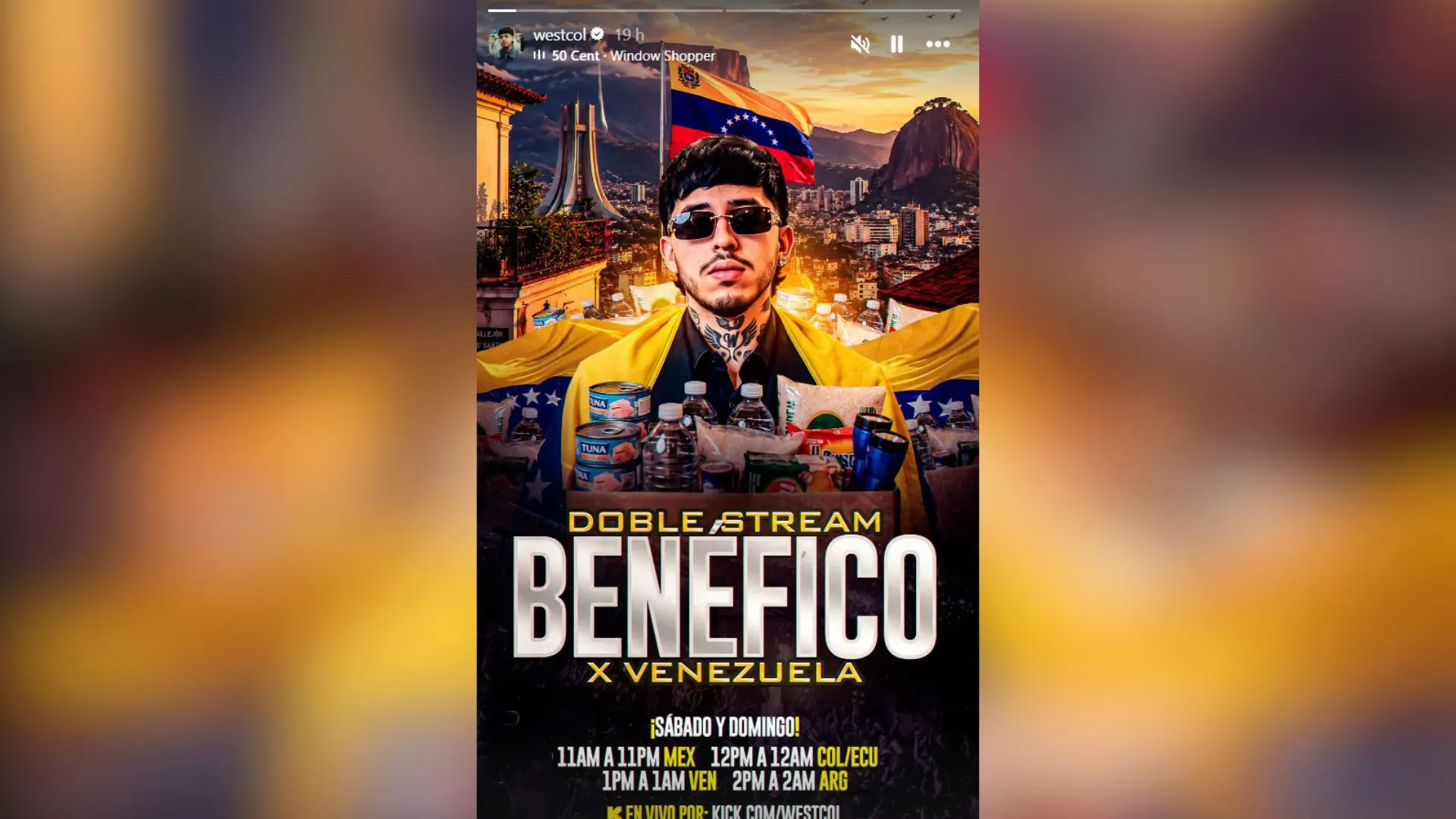
Foto: Instagram
Además de la recolección de recursos, Westcol aseguró que el objetivo es dar mayor visibilidad a la emergencia para incentivar a más personas a sumarse a las donaciones.
También busca viajar a Venezuela
Paralelamente al anuncio de las transmisiones benéficas, el antioqueño manifestó su intención de desplazarse hasta Venezuela para entregar personalmente parte de las ayudas y transmitir desde las zonas afectadas.
Sin embargo, explicó que actualmente enfrenta dificultades para organizar el viaje debido a las restricciones operativas en varios aeropuertos cercanos al lugar donde pretende ingresar.
«Estoy buscando vuelos privados para viajar a Venezuela y hacer streaming desde allá pero los aeropuertos más cercanos todos están cerrados… Sería mi primera vez en Venezuela y realmente quiero ir para aportar haciendo difusión y donando todo tipo de suministros.»
Incluso, pidió a sus seguidores compartir información sobre terminales aéreas que continúen operando y permitan facilitar el traslado.
«Cualquier info de algún aeropuerto cercano que esté en servicio me la hacen llegar».
Respondió a las críticas
Luego de que algunos usuarios cuestionaran la iniciativa, Westcol respondió que el propósito de las transmisiones no es obtener beneficios personales, sino utilizar el alcance de su audiencia para movilizar ayudas.
«El streaming se realizará para mostrar todo lo que está sucediendo y para que todos puedan contribuir con donaciones, es un canal de difusión».
También reiteró que los recursos obtenidos durante las emisiones serán destinados completamente a la compra de alimentos, medicamentos y otros insumos necesarios para las personas afectadas.
«Vi que mucha gente me está diciendo que por qué sacar provecho de algo así, pero todo va a ser donado; no es un tema de exposición o querer aprovecharse, lo último que quisiera es que se viera así, por lo tanto sigamos con el plan inicial».
El streaming se haría para mostrar todo lo que está pasando y que todo el mundo done dinero, es un canal de difusión.
Vi que mucha gente me está diciendo que por qué sacar provecho de algo así pero todo va ser donado no es un tema de exposición o querer aprovecharse, lo último… https://t.co/WPFvld9mQK
— WESTCOL (@WestCOL) June 26, 2026
Más figuras se han unido a la ayuda
La iniciativa de Westcol se suma a las acciones emprendidas por varios artistas y creadores de contenido que han utilizado sus redes sociales para apoyar a Venezuela tras la emergencia.
Entre ellos se encuentran el cantante Danny Ocean y la influencer Lele Pons, quienes impulsaron una campaña colaborativa para compartir información sobre personas desaparecidas, coordinar ayuda humanitaria y conectar voluntarios con las zonas donde más se requiere asistencia.
Mientras tanto, los organismos de socorro continúan atendiendo la emergencia y evaluando los daños ocasionados por los movimientos telúricos, al tiempo que diferentes sectores de la sociedad mantienen campañas de recolección de ayudas para las miles de familias afectadas.
La estadía de María del Pilar Rubio en México para acompañar a la Selección Colombia durante la Copa Mundial tuvo un inesperado contratiempo. La madre de James Rodríguez confirmó que fue víctima del robo de su teléfono celular, una situación que además le impidió acceder temporalmente a su cuenta de Instagram.
La información comenzó a circular luego de que el periodista César Sumoza publicara en sus redes sociales que la familiar del capitán de la ‘Tricolor’ había sufrido el hurto del dispositivo móvil mientras permanecía en territorio mexicano siguiendo el campeonato. Según indicó, la pérdida del celular también provocó inconvenientes para ingresar a una de sus principales redes sociales.
El hecho rápidamente despertó la atención de los seguidores del futbolista colombiano, quienes comenzaron a preguntar por el estado de María del Pilar y por lo sucedido durante su permanencia en una de las sedes del Mundial.
María del Pilar explicó lo ocurrido
Tras conocerse la información, la propia María del Pilar Rubio entregó detalles sobre lo sucedido mediante una nota de voz, publicada por en la que confirmó el robo y explicó que ya había logrado reemplazar el equipo hurtado.
«Como te parece que ayer me robaron el celular. Hoy ya lo compré y cuando se me restauraron todas las aplicaciones, menos el Instagram, no he podido entrar», expresó.

 (@enlamovidacol)
De acuerdo con su relato, la mayoría de las aplicaciones que utilizaba pudieron recuperarse luego de configurar el nuevo dispositivo. Sin embargo, el acceso a su cuenta de Instagram seguía presentando inconvenientes en ese momento, situación que la obligó a buscar alternativas para recuperar el perfil.
Hasta ahora no se conocen detalles sobre cómo ocurrió el robo, el lugar exacto donde se registró el hecho ni las circunstancias en las que desapareció el teléfono. Tampoco se ha informado si existe una denuncia formal o si las autoridades mexicanas adelantan alguna investigación relacionada con el caso.
Al parecer recuperó su cuenta de Instagram
Aunque inicialmente no podía ingresar a su perfil, posteriormente comenzaron a aparecer nuevas publicaciones desde la cuenta oficial de María del Pilar Rubio, lo que hace pensar que finalmente logró recuperar el acceso.
Entre las publicaciones más recientes se observan mensajes relacionados con la emergencia que atraviesa Venezuela tras los fuertes sismos registrados el pasado 24 de junio, además de información difundida para apoyar la búsqueda de personas desaparecidas y compartir mensajes de solidaridad con los afectados.
María del Pilar Rubio permanece en México acompañando a la Selección Colombia en la Copa del Mundo, como lo ha hecho en diferentes competencias internacionales, brindando apoyo al combinado nacional y siguiendo de cerca la participación del volante colombiano.
Por ahora, el episodio quedó como un inconveniente personal que generó gran repercusión entre los aficionados de la ‘Tricolor’, especialmente por haberse presentado en medio del evento deportivo más importante del fútbol mundial.
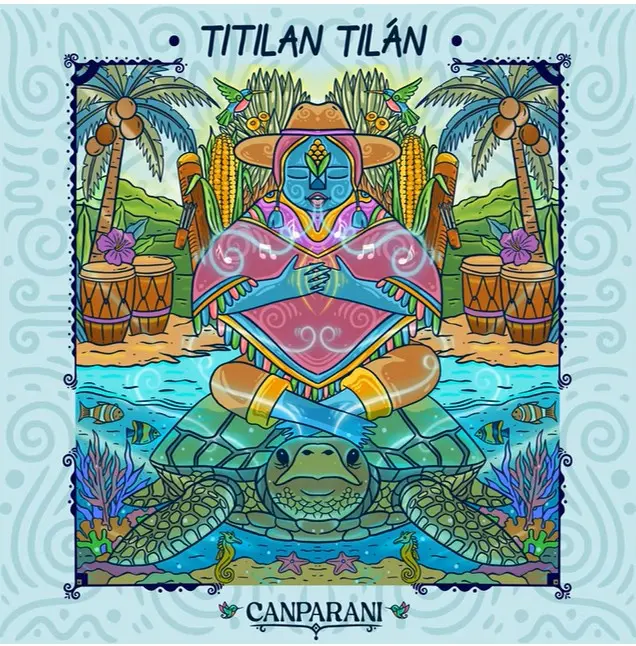
Minuto30.com .- La escena musical alternativa se renueva con una propuesta fresca, única y llena de buena energía. Se trata de «Titilan Tilán», una innovadora canción que fusiona el folclor andino con vibras caribeñas, creando lo que se ha bautizado oficialmente como la primera «carranga reggae interplanetaria».
El poder de la voluntad hecho canción
Con letra y música a cargo del compositor Mauricio Ramírez Orozco, esta obra del proyecto Canparaní va mucho más allá de ser solo una melodía para bailar. Su mensaje es profundo, reflexivo y altamente motivador.
La temática central de la canción explora dos pilares fundamentales para el crecimiento personal:
El poder de los hábitos: Cómo las pequeñas acciones diarias construyen grandes realidades.
La fuerza de la voluntad: El motor interno necesario para transformar nuestra vida y nuestro entorno.
Una invitación a cantar y vibrar alto
Más que un simple lanzamiento musical, «Titilan Tilán» es una herramienta sonora diseñada para elevar el ánimo. El creador extiende una invitación abierta a todo el público para escuchar la canción, dejarse llevar por este ritmo interplanetario y, sobre todo, cantar las inspiradoras afirmaciones que componen su coro.
¡No te la pierdas! Si buscas una dosis de positivismo, buena música y letras que alimenten el espíritu, esta mezcla de carranga y reggae es el nuevo himno que debe estar en tu lista de reproducción.
He has always been notably quiet in person and has seldom had a lot to say from stage.
But big speeches weren’t what people have wanted from Alan Jackson. They wanted the songs: “Drive (For Daddy Gene),” “Chattahoochee,” “Don’t Rock the Jukebox,” “Remember When,” “Small Town Southern Man,” “Where Were You (When the World Stopped Turning).” Those titles spoke volumes about Jackson as a singer-songwriter, and about the fans he served.
Related


Jackson caps his concert career Saturday (June 27) at Nashville’s Nissan Stadium with Last Call: One More for the Road — The Finale, a show that serves as a milestone in the Country Music Hall of Fame member’s career and a nostalgic reminder of his substantial body of work. But just as importantly, it highlights his influence. More than 35 years after Jackson reached the national spotlight, the ‘90s country that he helped define — marked by strong hooks, proud lower- and middle-class stories and an unapologetic use of fiddle and steel guitar — is hot. “Last Call” will feature appearances by a bundle of younger artists who took the baton, including Riley Green, Cody Johnson, Lainey Wilson, Eric Church, Miranda Lambert, Lee Ann Womack and Luke Combs, just to name a few.
They’re not the only music folks who’ll be on hand. The stadium will also welcome the four executives who headed the labels that oversaw his releases prior to this year: Tim DuBois, who signed Jackson to Arista Nashville; Joe Galante, who worked with him when a restructuring placed Arista under the RCA Label Group umbrella and, later, under Sony BMG; Mike Dungan, who signed him to Capitol Nashville; and Cindy Mabe, who succeeded Dungan at Universal Music Group Nashville (now MCA).
They collectively see Jackson as a key voice for the nation’s heartland.
“I call him the Norman Rockwell of country music,” DuBois says. “He just paints a picture that is so relatable to middle-class America.”
Jackson has amassed 26 No. 1 singles on Billboard’s Hot Country Songs among 50 top 10 singles, deftly using everyday language and unpretentious musical construction to create a bond with the genre’s listeners. He avoided gimmickry and never overplayed the emotional content in his material. Instead, he delivered his stories with sincerity and respect, using those tales as his primary means of communication. He could acknowledge commitment and economics in the same chorus — as he did when he sang “Livin’ on love, buyin’ on time” — capture intimacy in the lines of “When Somebody Loves You” and laugh at rejection in “She’s Got the Rhythm (And I Got the Blues),” the latter co-written with fellow traditionalist Randy Travis.
Jackson connected with men and women at the heart of their humanity, but he had his surface attractions, too.
“I know I sold a ton of music,” DuBois quips, “but I also sold a lot of long legs and long hair.”
A native of Newnan, Ga., Jackson communicated regular-Joe status through a love for the water and a passion for automobiles. He married his high-school sweetheart and kept cassette recordings of his songs in brown paper grocery bags, writing about his parents, his wife, his good times, his church and his growing pains. Fans saw him as one of their own — and he was. He still is.
But he wasn’t a pushover when it came to the music business. He needed a record company, but wasn’t about to sacrifice his identity to make it. Particularly as a younger man, he was prone to push back when the business people asked him to try marketing moves that didn’t fit his view of his art.
“He wanted it to be about the music,” remembers Dungan, who first worked with Jackson in the early days of his career. “When you’re the head of marketing, as I was at Arista, there are a million opportunities to fight with a man like that.”
And they did. Dungan remembers one brutally loud argument at a Nashville restaurant that turned the heads of other patrons. It wasn’t personal. Jackson simply had a public profile and — like most great artists — a sense of what he was willing to do when his name or likeness was attached. He knew what made his business work, and he didn’t compromise when it didn’t make sense.
“He was always on the lookout for anyone and everyone who was going to try to interfere with his creative process,” Dungan recalls.
Galante knew that side of Jackson, too. A year before Arista came under Galante’s leadership, Jackson registered a top 5 single with “Little Man,” a frank lament about the brute force of big businesses gobbling up market share in small communities. It wasn’t just posturing, but his own artistic success placed him in situations where he had to make choices between the music and the business sides of the music business.
When WHTZ New York, Z100, heard Jackson’s 9/11 reflection, “Where Were You (When the World Stopped Turning),” the top 40 station was interested in playing it. As a five-minute country ballad, “Where Were You” was a bit of an outlier for a pop station. The company was willing to accept that, but executive vp Butch Waugh funneled one request to Galante: Could Jackson remix it with less steel guitar? Galante called the artist with the proposal.
“The silence — it seemed like an eternity, but it was probably three or four seconds,” Galante recalls. “He said to me, ‘I kind of like steel.’ And the next thing I heard was a click. I went into Butch’s office, and he said to me, ‘How did it go?’ I said, ‘Well, as I expected, he’s not going to change the record. And I don’t think he should.’”
It’s not like Jackson was acting out of selfishness. Though his songwriting was a hallmark of his career, he recorded a fair number of outside songs, including 18 of his top 10 singles, such as “Little Bitty,” “It’s Five O’Clock Somewhere,” “Gone Country” and “Right on the Money.”
There was a practicality about it — invariably, the songs represented his love of classic country or expressed his viewpoint in a way that he didn’t think he could. The songs he selected and the compromises he refused to make were all a part of a genre that was central to his identity.
“He never lost his roots, and I think he always thought about that,” Galante says. “I mean, he was a shade-tree mechanic, coming from a small town, and still remembered what the struggle was like. I think that resonated in everything he picked, or wrote, and we worked.”
When Jackson left Arista, he called Dungan, who had moved on to Capitol, and suggested working together again. He acknowledged that they had had their share of arguments, but said he always knew that Dungan was giving him an honest assessment. He apologized for the long-ago restaurant squabble, and he laughed it off when Dungan said he wanted to get Jackson back on the radio. Jackson believed programmers had moved on.
“I was very shocked, because if you ever work with artists, you know none of them ever say that,” Dungan notes. “It’s the other side of the coin. It’s like they will not accept that radio won’t play them anymore. Here was a guy, who was very difficult in his early career, being the most grown-up adult in the room.”
The fact is that Jackson had a handle on what worked for him.
“Looking back,” says DuBois, acknowledging his own battles with Jackson, “he was right more times than I was.”
Jackson’s final concert is timely in a way he could not have predicted when he booked it more than a year ago. Back in 1989, Jackson — despite his longing for a recording contract — insisted on meeting DuBois’ boss, Clive Davis, before he became the first artist signed to Arista’s unproven Nashville division. Davis died on June 22, just five days prior to Jackson’s stadium show. Similarly, Larry Shell, who co-wrote “Murder on Music Row” — the award-winning 1999 release that excoriated the country industry for turning its back on tradition — died June 17. George Strait, who recorded “Murder” with Jackson, will participate in the concert.
Jackson’s legacy “matters so much, because the past, present and future of country music all connect together,” says Mabe, whose Joan of Arc Music is set to develop an NBC special out of the concert. “He’s an extension of Hank Williams, and what he’ll do for that next generation is they’re going to pick up the extension of Alan Jackson and move it forward. That’s why this concert and everything that comes in this moment is going to be so pivotal. It’s a cultural moment. It’s not just a last concert.”
Mabe’s production, of course, will need to demonstrate that through the music and through the other voices that might appear in it. Jackson, as someone who isn’t prone to talk much publicly, is certainly not one to boast. It’s not necessary.
The most talkative people in a room “tell you everything that they possibly know about anything,” Mabe observes. “The one with all the information is the quiet guy in the corner. That’s Alan Jackson. I’ll be honest, he knows a lot of stuff.”

All products and services featured are independently chosen by editors. However, Billboard may receive a commission on orders placed through its retail links, and the retailer may receive certain auditable data for accounting purposes.
Matt Damon is stepping into the studio and behind the mic for… a rap track?
That’s the premise for a new clip for Water.org, helping to promote the charity’s new “Get Blue” initiative. In a clip posted to Instagram earlier this month, Damon debuts his rap alter ego, “The Nomad,” to riff on the “constant struggle” to get water into the homes of those who need it most. The actor-turned-aspiring musician seeks advice from Hit-Boy, the Grammy-winning producer, who questions whether rapping is really the right move for Damon’s altruistic intentions.
“Isn’t ‘Nomad’ just ‘Damon’ spelled backwards?” Hit-Boy asks, to the chagrin of the embarrassed actor.
In person, Damon is anything but embarrassed to promote the Get Blue campaign, no matter what it takes.
“We’re always looking for ways to cut through all the noise, and sometimes, humor is a shortcut to get people’s attention,” he tells Billboard. “We’ll try anything, you know?”
Damon hasn’t had to rap in his career to date, though he notes that, “I sang in The Talented Mr. Ripley a long time ago and uh, I sung in Eurotrip.”
And while his kids are musically-inclined — “Taylor [Swift] is a huge influence in our house,” he says. “We know that catalog pretty well” — don’t expect to see Damon debuting any official musical endeavors anytime soon. “Obviously, Kendrick has nothing to worry about. I’m not gonna become a rapper,” Damon says. “I don’t think that would go well.”
For now, Damon’s rap attempt will just live on social media, with the actor also using his studio time in the clip to tell Hit-Boy about the millions of people around the world who still lack access to clean water. With the Get Blue campaign, Water.org is partnering with brands like Gap, Starbucks and Amazon, to launch products that give back. For every purchase of a Get Blue product on the Gap site, on Amazon’s Get Blue storefront (official page coming in July), or a purchase of two specialty drinks on Starbucks (the Iced Blue Coconut Matcha and the Blue Coconut Refresher), the brands will make a donation to Water.org.

NEW RELEASES
Shop Get Blue Products on Gap
The Gap collection includes blue-colored hoodies, T-shirts, baseball caps and accessories in unisex styles and sizing.
Amazon makes it even easier, with a dedicated Get Blue playlist for inspiration and a host of REDISCOVER playlists on Amazon Music, bringing back popular artists and songs in one place. Amazon says it will donate $1 to Water.org every time someone plays a participating artist’s REDISCOVER playlist. The exact list of artists will be announced in July.

Amazon Echo Dot (newest model)
An even easier way to make a difference: customers with an Alexa-enabled device can say, “Alexa, donate to Get Blue” and Amazon will contribute $5 on their behalf.
While much movement has been made to increase access to water and improve safe drinking conditions around the world, Damon notes that more than two billion people still lack access to safe water — that’s one in four people globally.
“It’s so hard for us to relate to growing up here,” Damon says. “You’re only a few steps away from a clean drink of water, whereas if you think about AIDS or cancer or things like that, usually there’s an emotional connection for somebody. You’re never very many degrees removed from somebody who’s struggling with that, whether it’s a family member or a friend.”

Get Blue Logo Baseball Hat
“What this [campaign] does,” he explains, “is it raises the awareness, and then hopefully, we can start this larger cultural conversation, and it’ll stay at the front of people’s minds.”
The Get Blue campaign continues the work that Gary White has been doing for decades, as the CEO and co-founder of Water.org. The charity works with local partners on the ground to offer small, affordable loans so families can get the pipes, pumps, or plumbing they need to serve safe drinking water at home. Education is also an important of their advocacy, with White noting that many young children in developing countries can’t attend school, because they are in charge of water collection for their families.
“So many people around the world, when they wake up tonight, they don’t know where they’re going to get their water, and they have to spend time and sometimes money just to get it,” White tells Billboard. “And with Water.org, we’ve pioneered some really innovative ways to kind of close that gap,” he says, noting the organization’s work in everything from building wells to facilitating clean sanitation.
“But what we also realize is we need to bring in a wider audience,” White adds. “It’s critically important that we have these partners who have a platform, who have a voice, who know how to connect through cool shirts or music, because that’s where people live.”
White’s goal for the campaign and for his organization: “We’ve reached over 90 million people with our water programs and I think in the next four years, we can reach another 100 million.”

Starbucks Physical Gift Cards (Multipack of 4 x $10)
Whether you’re ordering a fancy “blue” Starbucks drink or picking up a T-shirt at Gap, Damon says the Get Blue campaign makes it easier than ever to make a difference.
“When I was growing up, on our refrigerator, my mother had this quote from Gandhi, and it said, ‘No matter how insignificant what you do may seem, it is most important that you do it,’” he says. “And I’ve always thought about that. I think the problems of the world can feel overwhelming,” he continues, “but if everybody does their part, what you’re doing is not insignificant, because you’re going to save somebody’s life. You’re going to completely change the outcome of their life. And there’s nothing insignificant about that.”
Who knew Vice President JD Vance had Diddy jokes up his sleeve?
Vance visited the Richard Nixon Presidential Library to promote his memoir Communion: Finding My Way Back to Faith and was asked about a chapter that just so happens to be named “More Money, More Problems,”one of the late Notorious B.I.G.’s most popular songs. That’s when he quipped about the song’s producer, Diddy, being a “great Christian theologian,” before saying he’s “going to get in trouble” for the remark.
“I’m a millennial, and so I believe that’s the wisdom of the great Christian theologian P. Diddy, who as we found out in the last couple of years is very much not a Christian or a theologian,” the vice president joked about the embattled mogul after being asked why more money causes more problems. “I’m going to get in trouble for all kinds of things. That will be one of them. That will be in an attack ad at some point in the future.”
Diddy was sentenced to four years in prison last October on prostitution charges and is currently in the middle of appealing his sentence, which can take up to a year to be sorted.
Earlier this year, President Donald Trump revealed that Diddy asked him to consider a pardon through a handwritten letter. However, he said Puff’s criticism of him during his first run for president in 2016 “makes it more difficult to do,” even though the two have been cordial over the years.
Billboard has reached out to the White House for comment.
This week, Billboard’s New Music Friday Guide: Latin roundup — curated with key recommendations by Billboard Latin and Billboard Español editors — features a number of new songs and albums, including Bizarrap and Myke Towers’ “BZRP Music Session #42/66,” Becky G’s “Patrona” and Kane Rodriguez’s album Loco Soñador.
Released Wednesday, Argentinian producer Bizarrap dropped his latest music session featuring Puerto Rican artist Myke Towers. “BZRP Music Session #42/66” is the producer’s first session of the year. His previous one, “BZRP Music Session #0/66,” dropped in late 2025 and featured another Puerto Rican music icon, Daddy Yankee.
The music session with Towers was released in two different acts. In the first one, Towers’ signature melodic rapping style takes precedence while Bizarrap’s bass-heavy, hip-hop-driven beats deliver the undertone. Through the lyrics, the rapper pays homage to his roots, rapping about his elevated lifestyle while making it clear that Puerto Rico remains on his mind no matter where his career takes him.
In the second part of the collaboration comes “Boobytrap,” a long-awaited track that fans have anticipated ever since an early snippet surfaced years ago. In the trap-leaning rap song, Towers shows off his lyrical tenacity, rapping about his lifestyle and how he now has the respect he didn’t get before from others in the industry. The song title “Boobytrap” refers to a famous strip club in Miami, also named Boobytrap, which the artist claims to visit whenever in South Florida.
Meanwhile, artists such as Hermanos Espinoza, Kane Rodriguez, Fuerza Régida and Mariangela also dropped new music this week.
The most recent New Music Latin poll was topped by Feid’s El Moco Verde with more than 49.53% of the vote. Which release this week do you think is best? Give these new releases a spin and vote for your favorite new Latin music release below.
Editor’s Note: The results of the weekly New Music Latin poll will be posted if the poll generates more than 1,000 votes. This poll closes at 11 a.m. ET on Monday, June 29.