



No estamos solos en el universo; Steven Spielberg lleva años diciéndonoslo. Los extraterrestres están entre nosotros. A veces se esconden en nuestros armarios, con la apariencia de adorables ancianos con dedos brillantes (E.T.). Otras veces, descienden a la Tierra en naves nodrizas, inspirándonos a reflexionar sobre la vida, el universo y todo lo demás, incluso jugando con nuestro puré de patatas (Encuentros cercanos del tercer tipo). Spielberg nos advirtió que vigiláramos el cielo, no fuera que estos visitantes intentaran reclutarnos para zoológicos humanos (Firelight, una película de ciencia ficción que Spielberg, con 17 años, realizó en 1964) o exterminarnos por completo (La guerra de los mundos). Nos ha enseñado a buscarlos en cada rincón de la vida moderna, incluso si nuestro recuerdo de ellos termina siendo borrado por Will Smith (las películas de Men in Black, en las que Spielberg ha sido productor ejecutivo desde el primer día).
Ahora, uno de los grandes cineastas estadounidenses de los últimos 50 años ha vuelto al tema de los hombrecitos verdes, en un formato que prácticamente él mismo ideó hace cinco décadas: el éxito de taquilla de prestigio. Disclosure Day (El día de la revelación) da por sentado que a) los extraterrestres existen y b) el gobierno nos miente. Ambos conceptos se dan por ciertos y tienen la misma importancia, al igual que la idea de que los denunciantes son uno de los últimos grandes defensores de la democracia y que el poder del Estado se utilizará para silenciar a quienes intenten hablar. Sobre el papel, su última película parece un thriller paranoico de los años 70. En pantalla, luce como una película de verano de los 90, con todo el brillo de las grandes producciones. En realidad, este intento desacertado de aprovechar la ola de desconfianza y falta de fe en nuestras figuras de autoridad no podría ser más actual. Esta vez, los Hombres de Negro son los malos.
Recuerdan cuando Spielberg reemplazó digitalmente las armas en manos de los agentes del gobierno para el 20 aniversario de E.T., y luego expresó su arrepentimiento por la decisión? Imaginen que no solo restauró las armas, sino que creó una película completa de dos horas y media en torno a esa secuencia como una especie de mea culpa. Eso es El día de la revelación.
Spielberg nos sumerge en este thriller de conspiración mediática, con nuestro protagonista ya huyendo y los matones corporativos pisándole los talones. Daniel Kellner (Josh O’Connor, que una vez más irradia la esencia del antihéroe de los setenta) intenta esconderse a plena vista en un combate de lucha libre profesional cuando un matón le apunta con una pistola a las costillas. Lo escoltan hasta el estacionamiento, donde lo espera un elegante villano llamado Noah Scanlon (Colin Forth, elegante y malvado). Scanlon era el jefe de Kellner en Wardex, una empresa privada contratada para mantener en secreto el hecho de que, efectivamente, una “nave exótica” se estrelló en Roswell, Nuevo México, hace tantos años. La prueba del encubrimiento está en la mochila de Kellner. Él y algunos cómplices dentro de la organización quieren hacer pública la información. Scanlon quiere recuperar la información de la empresa y está dispuesto a matar a la novia de Daniel, Jane (Eve Hewson), si es necesario. Por suerte, Kellner tiene una baza: un “dispositivo”, uno de tres, que puede destruir ciudades, permitir a los usuarios “sumergirse” en la conciencia de otra persona, volver invisibles a grupos enteros de personas y, en esencia, hacer lo que sea que requiera la compleja trama de Disclosure Day para avanzar en la historia. El encuentro cercano termina en un punto muerto y una huida.
Mientras tanto, en Kansas City, Missouri, la meteoróloga Margaret Fairchild (Emily Blunt), su vecina de confianza, está teniendo un día extraño. Todo comienza con un cardenal creado por CGI que entra volando a su apartamento, interrumpiendo brevemente una discusión entre Margaret y su novio (Wyatt Russell). La rareza alcanza su punto álgido cuando, de repente, habla con un dialecto de otro mundo durante una transmisión en vivo, atrayendo así la atención de Scanlon y Hugo (Colman Domingo), el exempleado de Wardex que le confió a Daniel los discos duros con décadas de evidencia. De alguna manera, Margaret se ha activado por la presencia de ese pájaro. Ahora puede hablar cualquier idioma, leer la mente, hacer que la gente vea a sus seres queridos fallecidos y recibir transmisiones de información clasificada aparentemente de la nada; al igual que ese dispositivo alienígena místico, sus talentos, antes latentes, parecen transformarse y manifestarse según los caprichos narrativos del guion de David Koepp. Al igual que Daniel, ella también está huyendo. Pero fuerzas ajenas a su control los atraen el uno hacia el otro, y tienen una cita con el destino que lo cambiará todo, etcétera.
Cabe mencionar otros asuntos que se gestan en torno a las huidas de este dúo: la Tercera Guerra Mundial está a punto de estallar, manteniendo a todos en vilo. Hugo cuenta con un equipo de ayudantes que parecen estar construyendo un decorado —en concreto, una vieja casa suburbana— en un lugar desconocido, con un propósito que se revelará en el momento oportuno. Scanlon sigue controlando a Jane a distancia mediante ese dispositivo alienígena. También tiene un grupo de secuaces, uno bueno y otro malo, con la buena interpretada por la estrella de Hannibal, Hetienne Park, y el malo por Henry Lloyd-Hughes; si este último tuviera bigote, se lo pasaría retorciéndolo eternamente durante toda la película. La gran Elisabeth Marvel aparece como una monja que cuidó de Jane cuando era novicia y contemplaba una vida dedicada al servicio divino. La religión parece ser la única institución que la película aún considera pura y legítima, y un fuerte sentido de fe impregna toda Disclosure Day de una manera singular dentro de la filmografía de Spielberg. El Señor obra de maneras misteriosas, incluso mientras el propio director trabaja con solidez, dirigiendo desde primeros planos prolongados hasta emocionantes escenas de persecución con la misma destreza y asombro que ya esperamos de él.
También hay una fuerte sensación de fe respecto a la veracidad de las cosas, lo que no debería convertir a Disclosure Day en una película tan políticamente comprometida y, sin embargo, dado el mundo actual, podría decirse que la convierte en la película más política del verano. La palabra “verdad” se pronuncia más veces aquí que en cualquier película anterior de Spielberg, y estamos hablando de un tipo que hizo un drama serio sobre la publicación de los Papeles del Pentágono (The Post). Los thrillers de conspiración se basan en la emoción de sacar a la luz cosas que los que mueven los hilos quieren que permanezcan ocultas, y junto al asesinato de JFK, la mitología de Roswell es la piedra Rosetta para la brigada de los sombreros de papel de aluminio. Spielberg se divierte al preguntar: ¿Y si todo eso no es tan descabellado como todos pensábamos? Pero también sabe que el concepto de información pública como moneda de cambio y reconocer el simple hecho de que 2+2 no es igual a 5, independientemente de lo que diga cualquier Gran Hermano de turno, debería ser un requisito básico para cualquier discurso estándar en la sociedad civil. La realidad ha pasado del consenso al campo de batalla. Puede que el cineasta esté montando una campaña sensacionalista con este regreso a la ciencia ficción, pero parece creer sinceramente que la verdad está ahí fuera y que nos liberará.
Hay mucho que disfrutar en Disclosure Day: O’Connor demuestra una vez más su calidad de protagonista sin detenerse a conquistar; la singular habilidad de Blunt para hacer que todo, desde el desconcierto hasta la firmeza, pasando por un monólogo improvisado en ruso, parezca orgánico y arraigado en la realidad; la forma en que Colman Domingo dota a la frase «Siempre habéis sido vosotros dos» de la misma solemnidad con la que la mayoría de los actores interpretan las palabras de Shakespeare, Pinter y August Wilson; una toma de un coche saliendo de una granja —como si literalmente estallara por un lateral— que recuerda a la sensación que solían tener las películas de verano, pero que ahora rara vez transmiten. Y hay mucho que criticar, desde la forma en que los giros y revelaciones de la película resultan frustrantemente arbitrarios hasta un clímax que debería ser espectacular y, sin embargo, decepciona. Las reflexiones filosóficas nunca pasan de ser tertulias nocturnas en residencias estudiantiles y no terminan de encajar con los elementos más propios de una superproducción. David Koepp es, al igual que el director, un profesional consumado, pero es difícil evitar la sensación de que el guion, irregular y poco fluido, necesitaba varias revisiones.
Sin embargo, al final, sigue siendo una película de Steven Spielberg. Y si bien la calidad de su obra puede variar enormemente al considerar su trayectoria, subyace una pasión fundamental: por el cine, por contar historias a través de imágenes, por brindar al público una experiencia que despierte emociones intensas y genere adrenalina. Esto le confiere a su trabajo una vitalidad que evidencia la sensibilidad de un artista en plena creación. Para quienes crecimos con la Generación Tiburón, la idea de una nueva película de Spielberg es todo un acontecimiento, independientemente de si se trata de un éxito de taquilla o de una lección de civismo en la gran pantalla. Lo mismo ocurre con quienes se iniciaron en su obra durante la década de los noventa, cuando probablemente era el único director de Hollywood capaz de estrenar Parque Jurásico y La Lista de Schindler en el mismo año (!) y que todo encajara a la perfección.
Ese ADN cinematográfico de Spielberg está presente en Disclosure Day, y aunque este ejercicio de género tal vez no alcance las cotas de sus mejores obras del siglo XXI —entre las que destacaríamos se encuentran: Atrápame si puedes, Las aventuras de Tintín, Lincoln, Los fabelmans, West Side Story—, su presencia es más que suficiente para justificar la compra de una entrada. Además, tiene un extraño aire de cierre de ciclo, y no solo porque regresa al terreno fértil de Encuentros cercanos del tercer tipo y sus otros espectáculos de ciencia ficción. Se pueden apreciar rastros de todo, desde Duel hasta Minority Report, hasta el punto de que casi se convierte en una retrospectiva de su carrera en miniatura. Se le puede oír crujir los nudillos mientras dirige tanto las grandes escenas de acción como los pocos momentos más pequeños, efectivos e íntimos que aparecen. Sí, Spielberg cree que no somos el único juego que se desarrolla en el cosmos. Pero también cree que nuestra mejor naturaleza sigue intacta y que el cine aún tiene el poder de conmover y abrir corazones. Esta idea puede parecer anticuada para algunos, pero no resulta extraña en absoluto.
The post Crítica: ‘El día de la revelación’, la vuelta de Spielberg a los extraterrestres appeared first on Rolling Stone en Español.
Entre las miles de personas que durante el fin de semana se acercaron a Villa Domínico para despedir a Indio Solari, hubo dos que pasaron una noche entera mirando el asfalto. Mientras la fila avanzaba lentamente y los seguidores del Indio llegaban desde distintos puntos del país para darle el último adiós a su ídolo, Talo y Marcelo (o, como lo llaman sus amigos, El Fantasma), trabajaban sobre la calle para dar forma a una imagen que terminaría convirtiéndose en uno de los íconos de la jornada: un retrato monumental de Solari pintado directamente sobre el pavimento.
La fotografía aérea del mural, tomada desde un dron, recorrió las redes sociales y los medios de comunicación. El retrato del Indio, ocupando toda la calzada y rodeado por cientos de personas, fue la postal viral de una despedida tan popular como espontánea y conmovedora. El símbolo de un acontecimiento que quedará marcado en la memoria cultural de la Argentina.
La idea nació apenas se conoció la noticia de la muerte de Solari. “El viernes nos enteramos y fue algo impactante para nosotros. Tanto él [por El Fastasma] como yo somos muy fanáticos, sobre todo de Los Redondos”, cuenta Talo a Rolling Stone. Horas más tarde recibió el llamado de su compañero. “Me dijo: ‘Vamos a pintar al Indio’. Yo ni siquiera sabía que lo iban a velar en Villa Domínico, mi barrio. Cuando me enteré, se me movilizó todo el cuerpo”.
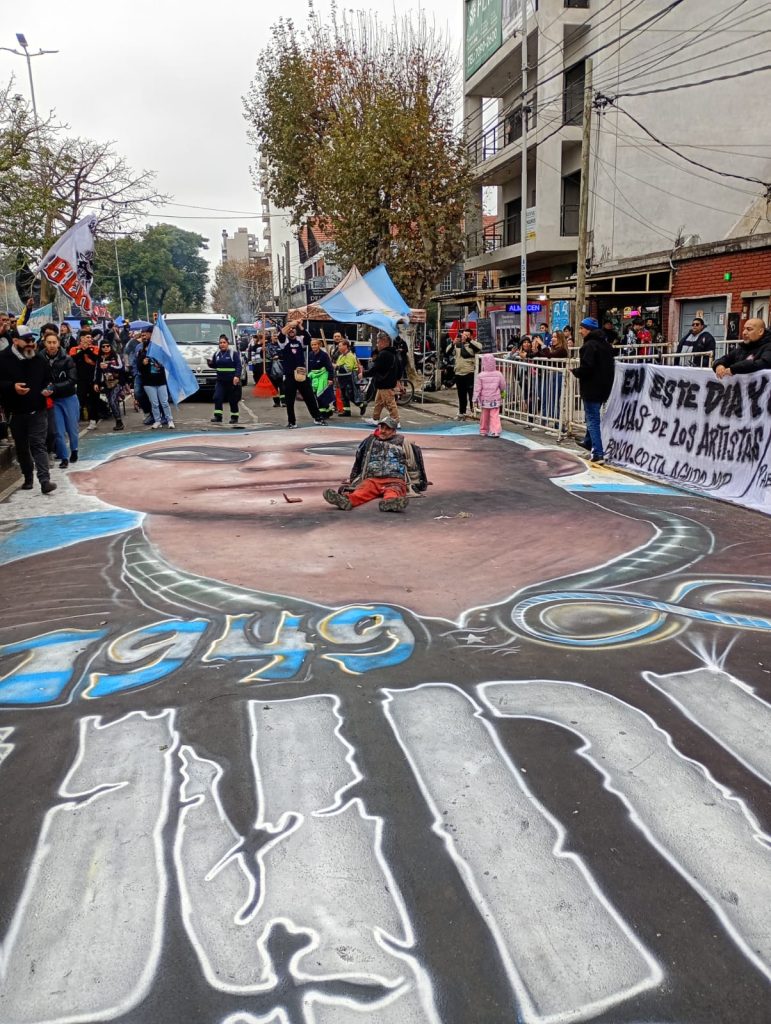
La cita fue a las 11 de la noche del sábado en la esquina de Posadas y Mitre, a escasos metros del Parque Domínico y del Polideportivo José María Gatica, donde se llevó a cabo el velatorio público. “Algunos chicos nos ayudaron a pintar el fondo de blanco y a marcar la cuadrícula. Después nos pusimos a pintar”, narra Talo. Lo que siguió fue una noche atravesada por el trabajo, la emoción y la colaboración colectiva.
Vecinos y amigos del barrio acercaron cables, consiguieron electricidad, ayudaron con los permisos pertinentes de la Municipalidad y organizaron un cordón improvisado alrededor del dibujo para evitar que la gente lo pisara mientras todavía estaba fresco. “Fue un conjunto de personas que se movilizó para lograr esto”, explica Talo. “Nos traían agua, café, algo para comer. Todo se fue dando de manera muy natural”.
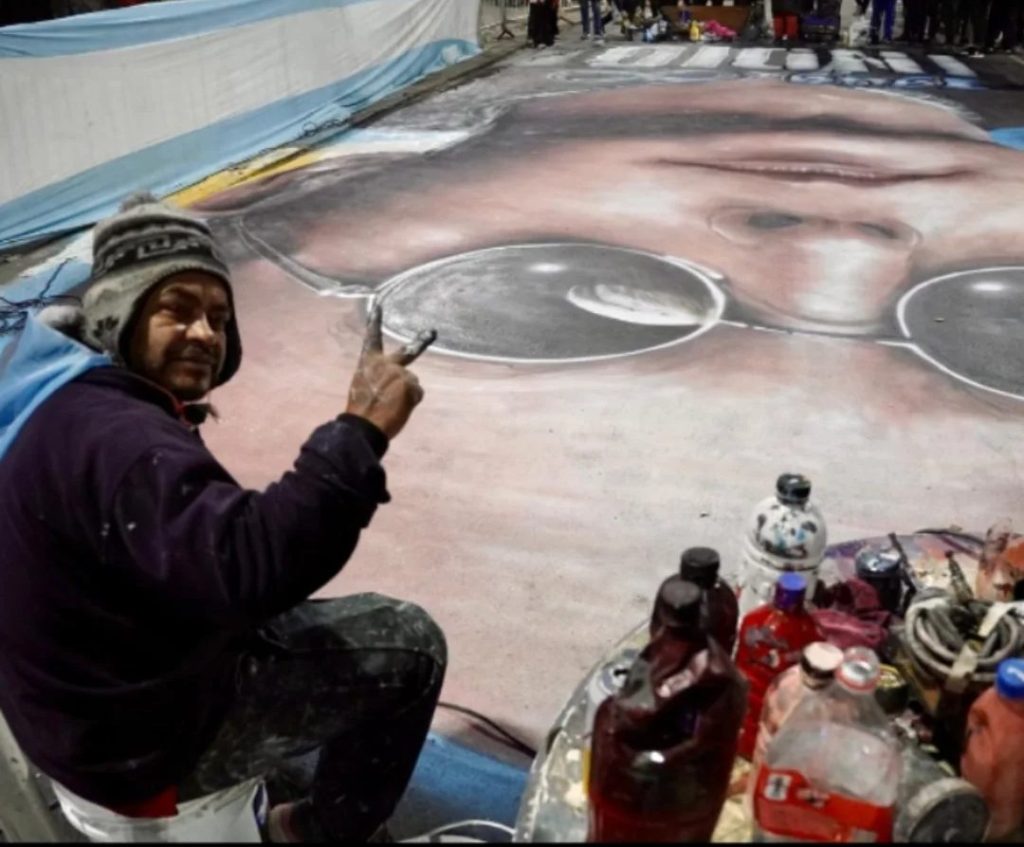
“Pensé que el Indio nunca se iba a morir”, admite. “Tuvimos el privilegio de que todo ocurriera ahí y sentí que no podía dejar pasar la oportunidad de brindarle algo como artista. Todo el arte que nos dio fue infernal. Esto fue una muestra de cariño de nuestra parte”, dice Talo y da más precisiones de su trabajo: “Los chicos dicen que fueron diez horas. Para mí fueron doce. Fue eterno”.
A medida que amanecía y la cantidad de personas aumentaba, también crecía la carga emocional del momento. “Cuando levantaba la cabeza veía los ojos tristes de la gente. Los míos también. A cada rato se me llenaban de lágrimas”, dice. “Miraba el mural y no podía creer lo que estaba viendo. Nunca me lo hubiese imaginado. Miraba para arriba y sentía que estaba él, y que le decía: ‘Qué guacho, el regalo que me diste’”.
La multitud comenzó a rodear la obra incluso antes de que estuviera terminada. Muchos se acercaban para agradecerles, otros para sacarse fotos o simplemente para observar el proceso. Algunos les acercaban bebidas calientes; otros se quedaban durante horas acompañando el trabajo. “Recibimos muchísimo cariño. Todavía no puedo asimilar todo lo que pasó”, reconoce Talo y se le quiebra la voz: “Fue demasiada energía junta”.
Gracias a la gestión de la organización, Talo pudo ingresar a despedirse de Solari. Cuando regresó al lugar donde estaba el mural, se recostó sobre el capó de su auto para recuperar fuerzas. “Volví shockeado y cansado, no daba más“, recuerda. En una de las imágenes aéreas tomadas por un dron durante la despedida, se lo puede ver allí, casi oculto junto a la obra que acababa de terminar.
Además del físico, el mural también implicó un esfuerzo económico considerable para la dupla. Entre pinturas y materiales invirtieron cerca de 200 mil pesos. “Nos dolió”, admite. “Estoy a cero”, agrega entre risas. Sin embargo, el objetivo nunca estuvo relacionado con una cuestión comercial. “No fuimos por eso. Lo hicimos por otra cosa”, dice. “Venimos de abajo, a puro pulmón, desde el anonimato”.
Talo y El Fantasma llevan años trabajando juntos. Realizaron murales, telones y banderas para distintas instituciones y especialmente para Independiente, el club con el que mantienen un fuerte vínculo. Sin embargo, nada de lo que habían hecho hasta ahora alcanzó la repercusión de este trabajo.
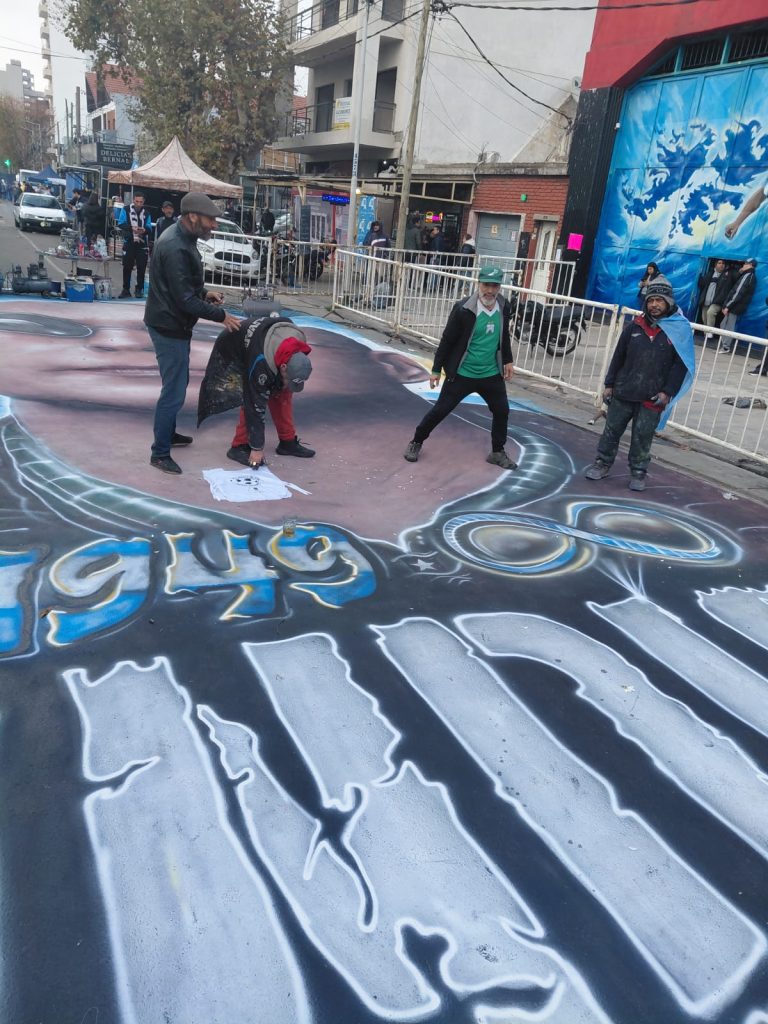
La técnica es la misma que usan para los telones de las hinchadas: cuadrícula, tiza, aerógrafo y manos a la obra. Talo labura en una punta, El Fantasma en la otra, cada uno con su mesita para mezclar pinturas. Y tratan de ganarse la vida de esa manera.
“La verdad es que todavía no puedo creer todo lo que pasó”, insiste Talo una vez más antes de despedirse. “No caigo de lo que estamos hablando, ni del quilombo que se armó con el dibujo del Indio. El mural quedó plasmado ahí y será para toda la vida. O lo que dure”.
The post El último pogo sobre el asfalto: la historia del mural del Indio Solari que se volvió viral appeared first on Rolling Stone en Español.
Who doesn’t love a long Weeknd? The international superstar’s After Hours Til Dawn Tour has become one of the biggest global treks ever, appearing in the top 10 of Billboard’s annual top tours chart for three of the last four years. But after reaching new heights last year, 2026 will be its biggest yet, generating another $440 million in ticket sales with more than 3 million fans in attendance.
Last year, The Weeknd set R&B records as the After Hours Til Dawn Tour became the highest-grossing and best-selling tour in the genre’s history, knocking Beyoncé and Bruno Mars off their long-held perches. But with this year’s brief stint in Latin America, more than 40 shows across Europe and a final run of 17 dates in Asia, it transcends genre altogether to become the highest-grossing tour in Boxscore history by a solo male artist.
According to figures reported to Billboard Boxscore, The Weeknd’s world tour has grossed $735.8 million and sold 5.8 million tickets since launching in 2022, current through his May 1 performance in São Paulo, Brazil. According to the tour’s promoter Live Nation and The Weeknd’s agency CAA, the remaining 59 shows push the trek’s total take well beyond $1 billion, joining tours by Coldplay and Taylor Swift in the exclusive 10-figure club.
The Weeknd kicked off the 2026 UK/Europe leg of the tour last night (June 11) at Manchester’s Etihad Stadium. He plays there again tonight before embarking on multi-night runs in Copenhagen, Madrid, Milan, Paris, Stockholm and more, including five shows at London’s Wembley Stadium in August. It’s the tour’s second trip to the continent, after 30 shows that collectively grossed $158.1 million and sold 1.6 million tickets in 2023. This summer’s run could approach double those earnings.
The tour’s final leg will mark The Weeknd’s first shows in Asia since a brief dedicated run in 2018. This time, he’ll play more than two times the number of shows, and, to match the tour’s other 159 dates around the world, elevate from arenas to stadiums.
As part of The Weeknd’s 2026 tour, he is partnering with Global Citizen and the United Nations World Food Programme, donating €1 from each ticket sold at all shows across Europe and £1 across shows in the United Kingdom to the FIFA Global Citizen Education Fund and XO Humanitarian Fund, respectively.
The After Hours Til Dawn Tour has evolved since its 2022 kick-off, then in support of After Hours and Dawn FM, the first two albums of a promised trilogy. In the immediate wake of record-breaking Billboard Hot 100 No. 1 singles like “Blinding Lights” and “Save Your Tears,” he placed two songs on the chart’s 2023 year-end roundup with “Creepin,” with Metro Boomin and 21 Savage, and “Die For You,” alongside Ariana Grande. He rounded out the trilogy with 2025’s Wake Up Tomorrow as his fifth No. 1 album on the Billboard 200, expanding the tour’s setlist to the scope of his entire career.
While it seemed like every other seat was filled by an at-first dejected and then wildly elated celebrity cheering on the New York Knicks to a totally improbable last-second victory in game four of the NBA finals on Wednesday night (June 10), one A-lister who couldn’t make it still grabbed massive headlines.
On Thursday (June 11), Nicole Kidman gave her enthusiastic thumbs-up to Taylor Swift, and Este and Alana Haim of the band Haim for representing with their custom Knicks name pun T-shirts. And while she didn’t specifically shout out Este Haim for rocking a hilarious “Knickole Kidman” shirt on game night, in her Instagram Story the Margo’s Got Money Troubles star told the trio that she was with them in spirit.
“Right there with you girls!” Kidman wrote over a video of Swift shouting and pointing to her shirt — which read “Stevie Knicks” — before the camera turns to Swift hyping up Este’s Kidman-coded top. Kidman also reposted the trio’s celebration video in which they danced to Cyndi Lauper’s 1983 Billboard Hot 100 No. 2 hit “Girls Just Want to Have Fun,” again lamenting that she could not be there to enjoy the good times.
“My girls!” she wrote in the caption. “I just wanna have fun!”
As just about everyone has seen by now, boy did they have fun! The trio — plus Law & Order: Special Victims Unit star Mariska Hargitay, also wearing a “Stevie Knicks” shirt — have been clipped into countless videos showing their wild enthusiasm during the game in which the Knicks improbably came back from a 29-point deficit to win as time expired, taking a 3-1 lead in the series.
Vogue caught up with Alana Haim after the game, to talk about her custom T-shirt/tote bag side hustle. They found out that the bassist/singer bought the royal blue shirts from Michael’s for $2.99 each and screen-printed them herself after getting a text from Swift that read, “I want to wear this shirt to the game, can you make it for me?”
Haim said she thought her pal would never ask, so then the two talked fonts and sizing, with Swift offering up her idea for a music-related Knicks pun, setting off a parade of punny ideas. “We really just wanted to have fun, because we were so excited that we were going to the game, and I thought it would make people laugh, so we put them on shirts and all decided to wear them,” she said.
And yes, Este brought an extra one, because she always does, to give to friends, which is how Hargitay ended up joining in on the action. For the record, third Haim sister lead guitarist/singer Danielle was also reportedly at the game wearing a shirt reading “Knickolas Cage,” but did not sit with her siblings on celebrity row.
Game five of the series will take place in San Antonio on Saturday (June 13), which, if the Knicks win it, would mark the team’s first championship if 53 years.

The big guy upstairs has been looking down on Tori Kelly, who drops her sixth and latest album God Must Really Love Me.
The new collection arrived at the stroke of midnight via Epic Records, and is home to the previously-released singles “Control” and “Dive” (which she reportedly wrote while seven-months pregnant).
The album explores love, identity and “the quiet work of protecting your peace amid the constant noise of the outside world,” and was announced some six months after the birth of Kelly’s first child with husband André Murillo. The press release shared that Kelly experienced a creative “urgency” like never before, as she locked into the songwriting process “with full-hearted conviction, frequently recording voice memos while nursing her son.”
The big guy upstairs.
“Before the baby was born I’d tried to work on as many songs as possible, because I thought maybe I wouldn’t want to write once I was in mom mode. But then everything just hit me at once and right away I knew what I needed to say and exactly how I wanted it to sound,” she remarks. “I really challenged myself to peel back the layers and go much deeper with my lyrics. In the past I’ve held back from getting too specific in my songs, but this time I just completely let go.”
In a change of tac, Kelly developed most of its songs in solitude before heading into the studio with such producers and co-writers as DIXSON (Kehlani, Vic Mensa), Nija Charles (Summer Walker, Kiana Ledé), Emily Warren (Dua Lipa, Noah Kahan), and Ammo (Beyoncé, Teddy Swims). Most of the album came to life in Los Angeles with her two main collaborators, Tommy King (HAIM, Donna Missal) and Dan Farber (Lizzo, Alessia Cara), although a string of songs emerged while touring Europe in summer 2025 with Ed Sheeran.
Kelly is supporting the new album with Forrest Frank for the 29-date The Jesus Generation Tour, which continues through to Aug. 1 at Globe Life Field.
God Must Really Love Me is the followup to Kelly’s 2024 self-titled album, Tori. Stream it in full below below.
Too much Olivia Rodrigo is never enough. That’s certainly the case for late-night owls who tuned into Jimmy Kimmel Live on Thursday night, June 11, as Rodrigo stuck around for her second performance in as many nights.
Rodrigo performed the world premiere of “stupid song,” which appears on her third and latest album, you seem pretty sad for a girl so in love.
After her performance Wednesday of “the cure,” Rodrigo toned it all down for “stupid song.” Wearing a white t-shirt, a light pink skirt and high-cut black boots, Rodrigo took her seat at the piano for the fresh cut, with support from a full band and backing singers. Those high notes, you bet she hit them.
Rodrigo is on the promotion trail for you seem pretty sad for a girl so in love, which dropped at the stroke of midnight and houses the Billboard Hot 100 No. 1 “drop dead.”
She’ll support the collection with a 65-date Unraveled Tour that will hit arenas for multiple night stands in North America, Europe and the U.K. this fall and winter, starting Sept. 25 show at PeoplesBank Arena in Hartford, Conn.
During her interview Wednesday night, Rodrigo explained to Kimmel the wholesome way she decided which tracks to drop ahead of the full release. “It’s really hard,” she said. “Last Thanksgiving, I was with my family, and they live in Wisconsin. It was all of us, aunts and uncles and cousins.
“I turned the lights off really low, because I was really shy, and I was so nervous to see their faces while they heard the songs for the first time,” she continued. “I played them the whole thing, and then they did ballots, and everyone cast their vote on what they thought the single should be … Everyone liked ‘The Cure’ the most. That was the No. 1 that we got.”
Watch Rodrigo’s performance below of “stupid song.”
Australia’s love story with Taylor Swift continues, as “I Knew It, I Knew You” (via Republic/Universal) opens at No. 1 on the ARIA Chart, an effort that places her in the frame with rock music royalty.
The single, which appears in the new Toy Story 5 film, is her 14th leader, a feat that sees her tie things up with the King, Elvis Presley, with the second most chart-toppers in Australia, ARIA reports. She has some way to go to challenge The Beatles, who top the list with 26, although all of the Fab Four and Elvis’ No. 1 hit singles came before the launch of the official ARIA Charts in 1983.
With that impressive start for “I Knew It, I Knew You,” Swift has now logged 35 weeks at No 1 on Australia’s singles chart.
There’s a Cinderella chart story for the late Mac Miller, as the decade-old “Cinderella” (Warner Music) featuring Ty Dolla $ign opens at No. 23, while Alyssa Grace bags a top 40 appearance with the independent release “Bloodstream,” new at No. 39.
Meanwhile, multiple ARIA Award winner G Flip grabs a new peak position with “Bed On Fire” (AWAL), up 33-28. It’s one of three homegrown titles on the chart, a list that includes Tame Impala’s “Dracula” (Columbia/Sony), which dips 7-8, and The Kid Laroi’s “Girls,” which reenters at No. 46.
Niall Horan’s Dinner Party (Capitol/Universal) turns into a feast on the ARIA Albums Chart, as the Irish pop singer’s third studio album opens at No. 1. That’s the second solo leader for Horan, after 2023’s The Show, while 2017’s Flicker and 2020’s Heartbreak Weather narrowly missed out, both peaking at No. 2. As a member of One Direction, Horan had four leaders: Up All Night (in 2011), Take Me Home (2012), Midnight Memories (2013) and Four (2014).
Australian audiences will get another chance to see Horan up close, when he visits the country for a four-date arena tour next February, produced by TEG and announced earlier in the week.
Also new to the ARIA Chart, published Friday, June 12, is Evanescence with Sanctuary (Columbia/Sony), their sixth studio album. It’s new at No. 2. The U.S. alternative rock outfit is on a healthy streak of top 10 appearances, with Fallen (No. 1 in 2003), The Open Door (No. 1 in 2006), Evanescence (No. 5 in 2011), Synthesis (No. 6 in 2017) and The Bitter Truth (No. 3 in 2021) all impacting the top tier.
Like Horan, Evanescence has just announced a tour of Australia in the early stages of 2027 (produced by Live Nation).
Completing an all-new top three is Malcolm Todd’s Do That Again (Columbia/Sony), arriving at No. 3, for his first ARIA Albums Chart entry. The U.S. singer and songwriter also appears at No. 10 on the national singles chart with 2024’s “Earrings,” unchanged at No. 10.
Fresh off their induction into the ARIA Hall of Fame on Thursday evening (June 11), Vika & Linda have the week’s best-selling homegrown release with Where Do You Come From? (Mushroom Music), the sister act’s ninth studio album. It’s new at No. 11, for their fifth top 10 appearance, a tally that includes a No. 1 with 2020’s career retrospective Akilotoa (Anthology 1994-2006).
“We thought this week couldn’t get any better. It’s ended with a bang,” the Bull sisters comment in a statement. “We’re blown away by the response to our new album ‘Where Do You Come From?’, thank you to everyone who got it to No. 1. We feel very lucky to have a wonderful team who have worked incredibly hard.”
Further down the list, Newcastle, New South Wales indie rock band Rum Jungle swings into the chart at No. 19 with the indepedently-released Marginalia, the followup to their top 10 release from 2025, Recency Bias.
Also, Freye Skye (Stardust at No. 21 via Hollywood Records/UMA), Pink Floyd (8-Tracks at No. 22 via Legacy/Sony), The Pretty Littles (Mulga Wire at No. 36 via CMI) and Vince Staples (Cry Baby at No. 37 via Universal) parachute into the top 40.
Taylor Swift is a superstar on another level. She shattered the all-time first-week sales record with last year’s The Life of a Showgirl and redefined what it means to be a touring juggernaut with her Eras Tour. She has 14 Billboard Hot 100 No. 1s, and 14 Grammy Awards. But the ascension of our biggest pop star didn’t start with the sales, and it didn’t start with the stage: it started with her songs. And on Thursday (June 11) night, Swift was celebrated for her first and foremost talent, songwriting, with a wildly deserved induction into the Songwriters Hall of Fame.
Despite being one of the most famous people on the planet, Swift attended the induction ceremony as anyone else might. She hobnobbed before the dinner started, and when the ceremony got underway, she sang and danced at her table during the various inductee tributes and performances. (She seemed particularly jazzed during John Fogerty’s ferocious set and Alanis Morissette’s haunting performance.) Joining Swift at her table was fiance Travis Kelce, future mother-in-law Donna Kelce, her own mother and father, as well as Steven Spielberg and his wife Kate Capshaw.
When it came time for Swift’s induction (the final one of the Class of 2026) it was a quarter to midnight. Sombr offered a glammed-up rock take on “Cardigan,” her 2020 Hot 100 topper, backed by the SHOF’s versatile house band. “It’s an honor to be here, thank you Taylor for trusting me,” he said. “This next song Taylor wrote when she was 19 years old and it really inspired me…I’m so nervous,” he stopped, laughing after fumbling a few words. “She’s looking at me right now and I’m talking about her music. I’ve never done anything like this.” (Swift, supportive as ever, applauded encouragingly.) Sombr then sang a, well, somber version of “Dear John,” a song hailing from Speak Now, an LP Swift wrote entirely on her own. Swift and her parents sang along, softly.
Swift’s Oscar-winning dinner guest had the honor of inducting her into the esteemed organization. “As a director I am acutely aware of the power music can have on audiences,” Spielberg said, noting that songs have the power to unite us anywhere and everywhere: “Whether it’s sung at the top of our lungs in our cars, in houses of worship, at football games or on the streets of Minnesota.”
So, why was one of the greatest living filmmakers on hand to salute one of our greatest living singer-songwriters? The short answer: she asked him. After receiving a phone call from her several months ago, Spielberg admitted that his elation quickly deflated after he hung up. “What could I possibly say about Taylor Swift that hasn’t already been said?” Spielberg pondered. “Out of curiosity, I asked AI how many words have been written about Taylor Swift.” The effort yielded him nothing. So he continued the experiment, asking AI how many words Taylor Swift herself has written. Once again, AI flopped the assignment. “She is such a force that the depths of her achievement defies AI,” Spielberg quipped.
When it was time for Swift’s big moment, she hugged Liz Rose (a songwriting collaborator from her early days who was inducted into the SHOF in 2023) and walked up to the stage.
The moment she opened her mouth, it was clear that Knicks Mania — which is currently gripping New York — had gotten the best of her. A hoarse-voiced Swift, who was courtside at Madison Square Garden Wednesday night with Kelce, admitted she spent the previous night “screaming for 100%” of the Knicks’ victorious game. “I got home and was like, ‘You gotta stop screaming, you’re screaming too much, you’re screaming instead of talking, you’re too excited.’ Then I got to witness the amazing performances I saw tonight, and I just kept screaming and I never stopped screaming and this is what you get. I make no apologies for that — I’ve had a blast.”
Swift shed some light as to why Spielberg was one of her personal heroes and her pick for the person to induct her into the SHOF. “Through his decades of spellbinding storytelling Steven Spielberg has unknowingly inducted me and countless others into his sacred club of expansive world building,” she explained, thanking him for joining her the same night his latest film, Disclosure Day, hits theaters. “I watched him ace every genre… because of examples like Steven’s I trusted my imagination.”
Later on, she thanked Sombr for his “perfect performance” of two songs that spanned a decade of her life. “His writing is so exceptional that it makes me envious and I love that feeling.” According to Swift, she’s always telling her friends, “Sombr is the future – he does it all on his own and he doesn’t need that AI. The kids will be fine!”
Throughout a thoughtful, well-paced and expertly written speech, Swift placed her songwriting within the context of her wider career and life.
“If I look back at my entire 23-year career in music, the ups and downs and industry battles, the trials and tribulations, the cheers and tears and dogpiling of doubt, the criticisms — both fair and unfair — the complete loss of privacy, the world tours and ego wars, and the twists of fate, the absolute magical chaos of this path that I chose when I was too young to remember it even being a choice at all, songwriting was the easiest thing I ever did,” she said. “Not because it didn’t take effort. It definitely did. Not that it wasn’t frustrating at times, because it could be. And not that my songwriting didn’t haunt me relentlessly until I cracked the perfect internal rhyme scheme for the third line of the second verse before my teachers called me out in class for not paying attention, because that definitely happened.
“But when I say that songwriting was the easiest part for me, I think what I mean is that it was instinctual. No one taught me how to do it. I had to be taught how to entertain a crowd. And learn choreography, and be less annoying and navigate the industry and fiercely protect my own sanity through difficult lessons and massive amounts of trial and error and chaos and calamity. But songwriting for me was pretty much the only thing I naturally did.”
Calm and collected throughout most of the speech, Swift faltered a bit when speaking about her family. “It was easy to choose songwriting. But for everyone else in my life, it couldn’t have been easy for my parents and my brother to pick up our entire family and move from Pennsylvania to Nashville,” she said, pausing after choking up a bit. “Even though words are kinda supposed to be my thing I will never be able to express my gratitude,” she told her family. “You are the reason I’m here tonight.”
Before leaving the stage, she offered up a quote from one of her favorite TV shows, Yellowstone, by way of advising the next generation of songwriters. “’It’s the one constant in life, son: you build something worth having, somebody’s gonna try to take it,’” Swift said in her best paternal Southern accent (which was aided somewhat by her strained vocal cords). “I’m using this quote to refer to self-worth, peace of mind and singular vision as a creator,” she explained. “Positive feedback and people loving what you wrote feels incredible… but you need to be ready to receive negative feedback,” she added. “If you make anything awesome, someone out there is bound to say horrible things about it. Or twist what you meant into something completely unrecognizable to you.”
Her advice? “You can be sensitive but also durable…. Take what’s useful and constructive and leave out what’s damaging to your creativity.”
Though she graciously kept a low profile before taking the stage, Swift’s star power was undeniable throughout the entire evening, something many of her fellow inductees couldn’t help but comment on. Walter Afanasieff mentioned it was the “joy of his life” to watch Swift sing along to a medley of his songs performed by Sheléa prior to his induction. Johnny Mercer Award honoree John Fogerty, when addressing the “dark” years he spent not playing his best-known songs in concert, joked, “Taylor Swift, I don’t recommend you do that.”
Swift’s induction as part of the Class of 2026 makes her the youngest woman ever inducted into the SHOF. Furthermore, she’s the first recipient of the Hal David Starlight Award (which the SHOF gives out to promising young talents; she nabbed it in 2010, and RAYE got it this year) to gain full membership. And as Linda Moran, Songwriters Hall of Fame CEO and president, said earlier in the evening, Swift seems to be on track for the organization’s highest honor, the aforementioned Johnny Mercer Award, if she keeps pace.
Billboard’s Friday Music Guide serves as a handy guide to New Music Friday’s most essential releases each week — the key music that everyone will be talking about today, and that will be dominating playlists this weekend and beyond.
Last week, we featured Taylor Swift, Niall Horan, Tinashe and more.
This week: Olivia Rodrigo releases her anticipated third album, You Seem Pretty Sad for a Girl So in Love; BTS drop a new song on streamers that had previously only been available on a vinyl edition of ARIRANG; and Jack White teases his just-announced new album, Frozen Charlotte, out next month…plus much more. Check out all of this week’s picks below:
Olivia Rodrigo, You Seem Pretty Sad for a Girl So in Love
After topping the Hot 100 with lead single “Drop Dead” and entering the top five with second single “The Cure,” Olivia Rodrigo’s third full length is finally here. You Seem Pretty Sad for a Girl So in Love delivers on what its two sections promise: songs about being a “girl so in love” (section one) and songs where that same narrator seems pretty down about it (“you seem pretty sad,” as section two is called). Standout track and third single, “Stupid Song,” seems to tug at the thread that unites those two sensations: feeling stupid. While it comes loaded with the declaration that “nobody’s wanted somebody more,” the humor is in the fact that, as the title suggests, such big feelings can seem rather silly in hindsight. For more, read Billboard‘s review and tracks ranked.
BTS, “Come Over”
In celebration of the 13th BTS Festa, an annual festival for ARMY, the global icons dropped “Come Over” on streamers. Previously, the thumping, hip-hop heavy track was only available as a bonus on the deluxe vinyl of the group’s March album, ARIRANG. The song was co-written by SUGA, RM and j-hope, among others, and co-produced by Grammy award winner Cirkut with SUGA and Ammo.
Jack White, “Dollar Bill”
Following the two-pack White released and performed as musical guest on Saturday Night Live in April (“G.O.D. And The Broken Ribs” and “Derecho Demonico”), the rocker returns with a new single from his freshly-announced new album out July 10. The bluesy “Dollar Bill” opens with a twangy western riff before exploding into classic White, who is most at home on any track when delivering lyrical riddles like: “You can’t control me/ Unless you owe me/ And you don’t own me/ Unless I owe you.”
Bebe Rexha, “One Day”
The newly independent pop singer, who partnered with Empire in January after a career with Warner, has dropped her first album since the move. Titled Dirty Blonde, the project mostly delivers high-energy dance-pop bangers, but “One Day” stands out from the rest not only for its mid-tempo production but mostly for its honest lyrics, which Rexha co-wrote. And while it’s likely about a former flame, it could just as easily be a message to Rexha’s fallen fans: “One day, you’ll realize just what you lost/ By then, you’ll be nothing more than an afterthought.” Who needs ’em, right?
Infinity Song, INFINITY SONG
Alt-rock sibling band Infinity Song has released its self-titled debut album today, and it delivers on the exact type harmonies and tightknit writing that can only come from that kind of bond. “We grew up studying music together, performing together and learning how to listen to one another,” the Boyd siblings shared in a statement. “This album gave us the space to lean into our individual strengths while pushing ourselves as musicians…we’re proud of how expansive the record became without losing the intimacy that’s always been at the heart of Infinity Song.” The album was recorded between the Boyd siblings home base of New York and Los Angeles.
A Hall of Fame celebration is typically a chance to bury hatchets, to raise a toast, and to remember the tunes and artists that turned you on during the formative years.
When ARIA inducted six acts into its Hall of Fame on Thursday evening, June 11, the occasion presented a the industry with a chance to take stock, and identify the battles that lay ahead. Specifically, artificial intelligence and its profound threat (and opportunity) to the creative community.
At the tail-end of 2025, Australia’s Productivity Commission completed a year-long inquiry with the publication of its final report on Harnessing data and digital technology. In it, the Commission concluded it would be “premature to make changes to Australia’s copyright laws,” despite lobby efforts from big tech.
That followed Attorney-General Michelle Rowland’s announcement that the federal government wouldn’t water-down existing copyright protections, essentially shutting down the creative sectors’ concerns that an exemption would be carved out for text and data mining (TDM).
The music industry shifted into gear, as the likes of ARIA Award winners Missy Higgins and The Presets’ Julian Hamilton, and Midnight Oil frontman and former Labor frontbencher Peter Garrett, and 2026 ARIA Hall of Fame inductee Kate Ceberano stepped up to advocate for rights holders.
“Our opportunity to shape how AI influences music and what Australian music looks like for generations to come relies on us all getting it right in this regulatory and political moment,” ARIA CEO Annabelle Herd remarked at the top of the 2026 ARIA Hall of Fame. “Getting this right means everyone wins,” she added, pointing to artists and rightsholders, tech platforms, consumers, music fans, and the Australian economy.
AI, and the conversation around it, is everywhere right now. Just this week, the trade body clarified its position on AI generated music ahead of the 2026 ARIA Awards. Going forward, “recordings/items that incorporate elements of Artificial Intelligence (AI) may be submitted for entry, but only if a human is the primary creator of such recording/item and the human contribution is substantial and meaningful,” reads the updated ARIAs guidelines. AI cannot be the sole or central element of any recording/item that is submitted for entries” and any AI services or tools used to assist in the creation of any potential nominees “must be a properly authorized and lawful service/tool.”
The industry will be like a dog with a bone on AI, Herd insists. It won’t give up.
“Our opportunity to shape how AI influences music and what Australian music looks like for generations to come relies on us all getting it right in this regulatory and political moment,” she said during her comments at the top of the HoF.
Read Herd’s opening address at the ARIA Hall of Fame 2026:
Good evening, and welcome to The ARIA Hall of Fame 2026 Special Event.
I want to thank Binowee for that beautiful Welcome and pay my respects to Gadigal elders past and present, and to all the First Nations artists, storytellers, colleagues, and friends in the room tonight.
I’d like to welcome Tony Burke, Minister for the Arts; former Prime Minister of New Zealand, Jacinda Ardern; Susan Templeman, Special Envoy for the Arts; Senator Sarah Hanson Young; and Millie Millgate of Music Australia.
Thank you also to NSW Music Minister John Graham who can’t be here tonight and Sound NSW, Music Australia, and the Office of the Arts for supporting this event.
From the bottom of our hearts, we are grateful for your deep support and passion for Australian music and our industry. Through a difficult time of disruption and transition with lots of challenges, we know that you have our backs and are doing everything possible to enable Australian music to flourish.
This is the first time the Hall of Fame has stood as its own event since 2010. The reason we wanted to bring it back this year is – of course – that it is the ARIA Awards’ 40th birthday which is a chance to pause and think about everything that got us here: who took the early risks, who played the rooms we still play in and opened the doors that everyone’s walking through now.
It is also a chance to induct a group of very deserving artists on a night which is all about them.
The six artists being inducted – Gurrumul, Jenny Morris, Kate Ceberano, Spiderbait, The Living End, and Vika and Linda – between them have shaped what Australian music sounds like, through extraordinary songs and records, magnetic stage presence, and all the joy and emotion they have gifted us over the years. Lucky for us we get to spend the next few hours celebrating this incredible achievement properly together and with them.
A huge and warm welcome to our inductees and to family, friends and the people who have been part of the journey to this moment. We have a very special evening planned for you all and I hope that it is a night that you will always remember and treasure. You might want to keep the tissues on hand, we did manage to get Tim Rogers to cry last year so…
A 40th anniversary lets you reflect and think hard about where we are and what comes next. As we gather tonight there are several very important national conversations happening, the outcomes of which will shape the future of Australian music and impact generations of artists going forward.
The big, inescapable one is obviously AI.
This year, the skies between the U.S. and Canberra have been busy with planes carrying AI and tech company CEOs and senior executives to Canberra. They arrive waving very large cheques and promising generation-defining investment in Australia, provided we make some “tiny” tweaks to our copyright laws to remove consent and control from artists and rightsholders.
Our opportunity to shape how AI influences music and what Australian music looks like for generations to come relies on us all getting it right in this regulatory and political moment.
Getting this right means everyone wins: artists and rightsholders, tech platforms, consumers, music fans, and the Australian economy.
For artists and rightsholders, getting this wrong means losing consent and control over how your work is used by AI. Being forced to watch your life’s work disappear into someone else’s AI product to be exploited and monetised without permission or anything resembling fair payment. And it’s hard to even conceive of the damage if AI has unfettered access to extract and exploit thousand of generations of First Nations culture and storytelling.
A country with a creative and media culture as strong as ours will not rewrite its laws on the advice of the people who stand to profit most from dismantling them. Tech companies do not decide how an artist’s music is used, on what terms or at what price. That is the prerogative of the artist and the copyright owner.
We thank Minister Burke, the Attorney-General, Michelle Rowland, and others who have stood firm with creators so far in the face of this immense pressure. All we can say is hold firm!
But tonight, let’s leave AI at the door and live and be fully present in this very special and very human moment.
This is a room of people who love music, who love Australian music and the artists who made it. And tonight, we ask that you show the love. Be loud, be warm, get up and dance and sing along wherever you feel like singing (as long as it’s during a performance). These six have earned every bit of it.
A huge thanks to the amazing ARIA team, Second Sunday event production team, and the Roving broadcast crew for the huge work and love that goes into a night like this; to the ABC for broadcasting the Hall of Fame to Australian audiences, and to every one of you for being here. We’ve got a good one for you, let’s go!