




Hace dos años, House of Vans Ciudad de México organizó un concurso para elegir a una de las bandas que participaría en su ya conocido Bazar de Bandas que toma lugar en el Parque Bicentenario. Entre los proyectos independientes que se presentaron aquella noche, destacó la presencia escénica de Gael Briones —mejor conocido como Galo Barker— un compositor, productor y músico multi instrumentista nacido en Puebla, México, que acababa de presentar su segundo EP, DEMOKID.
Aquella noche, Galo se llevó la victoria del concurso y, semanas después, se presentó en el mismo escenario que Juanpalitoschinos durante el festival. A partir de ahí, muchos de los asistentes lograron descubrir una de las propuestas artísticas mexicanas independientes más interesantes de los últimos años. Pues, con apenas 23 años, se caracteriza por construir desde el riesgo, sin miedo a explorar y experimentar en su sonido, creando nuevas propuestas dentro de la escena musical.
Aunque muchos lo conocieron a partir de DEMOKID, su camino comenzó tres años antes con Dead of Blue Bird, un EP completamente en inglés donde predominaban las influencias del indie alternativo y el R&B, con una propuesta mucho más cercana al rock que la que desarrolla actualmente. Desde entonces, su música ha evolucionado sin perder esa curiosidad por mezclar géneros y reinventar su sonido. Paralelamente, trabaja de tiempo completo como productor musical, colaborando principalmente con artistas emergentes originarios de Puebla, una faceta que también ha moldeado su forma de entender la música.
Después de DEMOKID continuó lanzando sencillos que eran tan buenos, que parecían imposibles de superar, pero Galo siempre lograba hacer magia. Era una gran canción tras otra, como ‘X AQUÍ’, ‘UNNO’ y ‘NRML’. No fue hasta el 16 de octubre del año pasado, con el estreno de ‘SI T VAS’, que la cosa se comenzó a poner seria: Galo estaba preparando su (esperado) álbum debut.
Entre reggae, rock, jazz, R&B, indie y mil géneros más sin etiqueta, sacó cuatro sencillos más, que terminarían formando parte de WOOF, lanzado el pasado 1 de julio de forma independiente. En este proyecto, Galo fungió como compositor, productor e intérprete de las 11 canciones que lo conforman, colaborando con Abu Barret en tres de ellas, y con SASH en una. Es por eso que, en ROLLING STONE en Español, nos reunimos con el artista para descubrir que hay detrás de la mente creativa de Galo Barker, el camino que lo llevó a WOOF y la filosofía que ha construido alrededor de su música.
Primero que nada, ¿quién es Galo Barker?
Soy un músico y productor. Tuve este acercamiento a la música desde muy morrillo y, poco a poco, alrededor de Galo se ha construido una comunidad de músicos en Puebla. Realmente, yo, Gael, siempre le doy crédito a toda la gente que se involucra en el proyecto. Entonces, creo que para mí el ser músico, el ser productor y todo eso, va de la mano con la gente que está apoyándonos y con la gente que se suma al proyecto. Yo diría que Galo es como el conjunto de todas estas experiencias, personas y, en especial, obviamente, la música.
La música ha estado bien presente en mi vida desde bien temprana edad, no conozco otra cosa. Más bien, no hay algo más grande, fuera de la gente, que la música. Es esa combinación de cosillas que hay, de rock and roll, de latino, de todo un poco. Siento que me gusta ser bien diverso y, principalmente, me gusta mucho poder estar en el escenario, poder estar en la música y poder estar con los panas. Siento que esto me ha permitido ser yo cada vez más y conocerme más.
Mencionas que la música te ha acompañado desde que estabas muy chiquito. ¿Cómo inició ese acercamiento con todo este lado más musical y artístico tuyo? ¿Y cómo pasó a iniciar el proyecto musical de “Galo Barker”?
Mi bisabuela era soprano, cantaba ópera; mi abuela paterna también toca la guitarra; mi tía, mi papá… Por ese lado de la familia, muchos han tenido acercamiento con la música. Desde muy chiquito crecí con jazz, blues y rock. Mi papá siempre me mostró mucha música. Por el otro lado, mi mamá es muy versátil; le encanta la cumbia, el rock, le gusta de todo. Ella siempre me impulsó porque, por ejemplo, a mí no me gustaba ir a clases de música y ella me obligaba. Era como: “Tienes que ir a clases de música” y, obviamente, a la fecha es algo que le agradezco.
Yo iba a estudiar zoología, no música. Me encantan los animales, trabajé en un rancho como cuatro años. Cuando eres joven y no tienes idea de lo que es la industria musical, tienes todas estas barreras de “yo no puedo estudiar esto porque no voy a comer”, por eso mi primera opción fue otra cosa. En la pandemia me compré una interfaz de audio para grabar música en la computadora. Ya hacía música y grababa con mi celular, pero nada estructurado. Fue en ese lapso cuando empecé a grabar muchísima música: cuatro o cinco rolas a la semana. No sabía nada de producción ni de audio, pero las ganas de hacerlo te llevan a buscar cómo. YouTube fue mi maestro.
Mi mamá escuchó las rolas que había hecho y me dijo: “Pues están chidas tus rolas, pero aquí no va a pasar nada. Tienes que salir a tocar, tienes que sacarlas. La artisteada es cuando eres morro y tienes que darle full o nada”. Entonces empecé a hacer mis portadas, pagué la distribuidora para Spotify y en pandemia saqué mi primer EP. Todavía cantaba en inglés. De ahí decidí estudiar Producción Musical. Al entrar a esa carrera me di cuenta del amplísimo mundo que es la industria musical. No solo tienes que ser un rockstar o una superestrella; puedes ser mánager, productor. Desde ahí supe que eso era lo que quería hacer. El primer paso es subir tu música y compartirla con la gente.
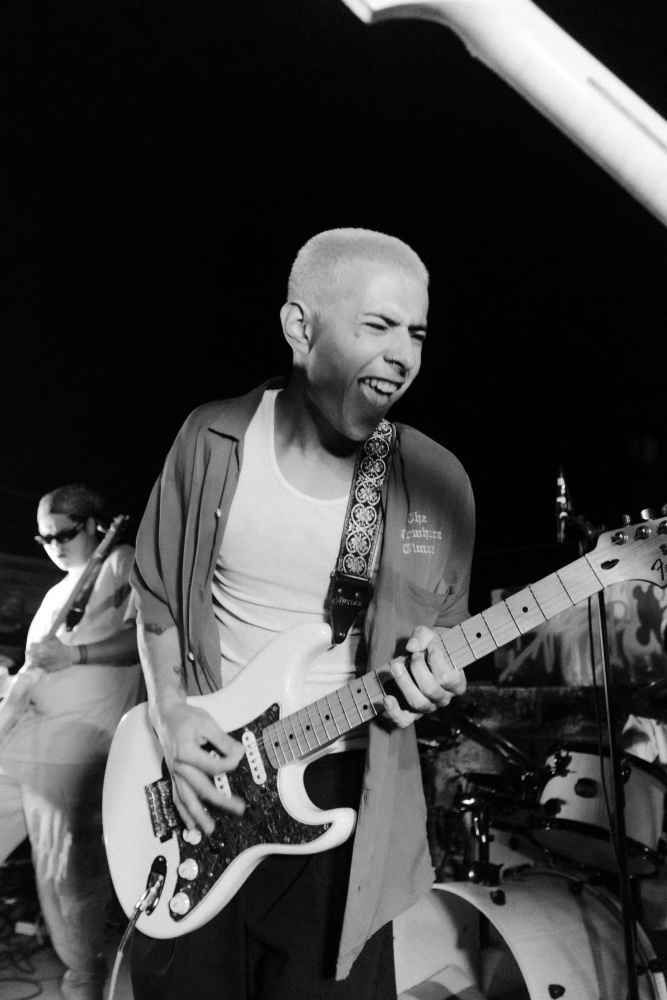
Después de ese EP sale DEMOKID. Ahorita, escuchándote, me doy cuenta que haces muchas referencias a todo lo que te pasó, porque también hay una canción donde dices que ya no cantas en inglés.
Es chistoso porque cuando entré a esta universidad de música, realmente en mi entorno no había músicos, y Puebla es un estado donde, en ese momento, todavía carecía mucho de proyectos independientes. Casi todo lo que había aquí eran bandas de covers y cosas así; no había mucha gente haciendo música. Actualmente sí, pero en ese entonces no. Entrando a esta escuela fue que empecé a conocer muchos músicos, y ellos me empezaron a enseñar música en español. Topa que yo en la prepa iba a las fiestas y me gustaba mucho el reguetón y el Rels B, pero era algo que yo no consumía. Yo en la prepa era el más fan de los Rolling Stones.
Entonces, estos panas de la universidad me empezaron a enseñar música en español y lo que era el urbano actual. Recuerdo que escuché a ‘BAD BITCH’ de Ca7riel, mucho antes del Tiny Desk y fue justo mi referencia más dura para DEMOKID. De ahí me empecé a empapar de este urbano en español, medio alternativo, medio funky, y el producto fue como esta sátira de “yo nunca he sido rapero, pero me gusta hacer música”. Entonces, de ahí nació todo este concepto. La neta no esperábamos que le fuera tan chido. Justamente fue el primer proyecto en español y todo fue sucediendo como a veces tiene que pasar. Nos abrió muchas puertas y estamos muy, muy agradecidos con ese EP, que nos hizo conocer a bandita chida.
Ay, es padrísimo. A mí me encanta. ¿Lo hiciste cuando seguías en la universidad?
Sí, justo. Fue en mis años de la uni. De hecho, hasta aproveché y lo entregué para varios proyectos.
¿Y qué te dijeron tus profes?
Que estaba chido. De hecho, justo en mi proyecto de titulación, cagadamente, un profe me dijo: “Está chido, pero está muy acá, muy alternativo”. Y yo era como de “No, profe…”.
No entiende la vibra.
Sí, fue esta exploración de escribir en español, porque también, la neta, creas o no, es mucho más difícil el español que el inglés cuando sabes inglés. Porque, si te pones a analizar un poco la música, muchas veces el mensaje en inglés es bien vacío, ¿sabes? O cualquier cosa se escucha bien. En cambio, el español, gramaticalmente, es más difícil de rimar y de que diga algo chido. Fue un salto bien abrupto, pero también bien chido. Obviamente, en la uni aprendí un poquito más de ingeniería y salió chido, la neta. Lo aprecio mucho. Al inicio no lo iba a sacar.
¿En serio DEMOKID no iba a salir? ¿Cómo fue que decidiste sí sacarlo?
Fue más un tema de que ya había hecho casi todo, y creo que muchas veces, como músicos y como personas en general, nos gana el orgullo. Como dicen, tú eres tu peor enemigo. Entonces, siempre nuestros juicios ante lo que hacemos son muy duros. Algo que he aprendido, y de hecho con este disco que acaba de salir creo que es lo que más he aprendido, es que la música es un proceso. Yo en ese momento perseguía la canción perfecta, para mí era de que tenía que darle a la rola. No tanto que fuera un hit ni nada, sino algo que me llenara. Pero no entendía que apenas estaba en el proceso de buscar y de saber quién era.
A la mera hora de escucharlo, para mí no estaba chido. Pero ya habíamos hecho fotos, ya medio había hecho portadas y, unas dos semanas antes, dije “ya no lo voy a subir”. Mis panas me dijeron “Estás, güey, súbelo, está chido”. Y pasó lo que tenía que pasar. Me hubiera arrepentido mucho de no haberlo subido.
Y retomando lo del lenguaje, creo que algo que define mucho tu música, es la manera en la que escribes tus canciones. Tienes un lenguaje muy relajado, muy natural, muy Galo. ¿Cómo logras crear esa narrativa o ese lenguaje en tus propias canciones?
Yo soy productor. Realmente llevo ya dos años produciendo a mucha banda, entonces muchas veces te apoyas de los procesos de las demás personas y, obviamente, eso lo implemento en lo que hago. Considero que a lo mejor lo que ayuda a que se sientan, como dices, relajadas o sueltas, es que en especial, DEMOKID era una etapa de soltura y diversión. Tenía muchas ganas de hacer algo así porque venía del indie, que era más chill. También sirvió mucho porque DEMOKID sucedió durante el transcurso en que empecé a tocar en vivo. Yo nunca había tocado en vivo y, la neta, el en vivo escaló súper rápido. Nuestro tercer show fue en Sala Forum, que es de los foros ya un poquito chidos de aquí de Puebla, y fue mucha gente. Entonces, el escenario también me enseñó sobre la energía de la música, de cómo se transmite y de la importancia de transmitir. Porque siento que yo pensaba mucho en el sonido.
Y el en vivo te baja a la realidad; es todo lo contrario. Es cómo logras hacer sentir a la gente con cómo suena tu música. Siento que eso también influyó en mi manera de soltarme. Me volví menos tímido, porque siempre he sido un poquito timidón. Entonces, creo que eso también ayudó al proceso de que sonara así.
Además DEMOKID te trajo a tocar aquí en la ciudad, que fue en el House of Vans, ¿no?
Justo, sí. También aquí en Puebla hay un festival. El festival más grande que pasa aquí es el Tecate Comuna. Y justo, en un concurso, logramos pasar y tocamos; abrimos el Tecate. Creo que fue nuestro cuarto show. Realmente DEMOKID fue algo que no iba a suceder y acabó siendo la puerta a todo.
Ha sido un viaje. Y ahora pasemos a tu álbum debut, que está llegando dos o tres años después de ese EP. Cuéntanos de WOOF.
Actualmente mi trabajo al cien por ciento es producir y mezclar para otros artistas. Cuando te gradúas empiezas a decir “ok, hay que comer, hay que chambear”, y así empecé a dedicarle más tiempo a las producciones, a producir otros artistas, y realmente me tomó casi año y medio en el que casi no hice nada mío. Sí toqué y todo, pero casi toda la música que trabajé era para otras personas, que fue algo muy bello y muy chido. Obviamente, todo suma. Pero sí llegó este punto donde dije: “fuck, necesito hacer música”.
Este proceso también estuvo acompañado de que, justo por DEMOKID, nos cayó nuestra primera oferta grande de un label, que al final no tomamos por muchas cosas. Pero esta oferta era hacer un disco anual y desde ahí entró una chispita en mí de pensar en qué haría yo ahorita si tengo que hacer un disco. También, como artistas —bueno, personalmente yo—, siento que idealizamos mucho la idea de un primer disco. Que tiene que ser un hit o grabado en estudios carísimos. Y, chistosamente, todo este año de producir y de conectar un poquito más con la música me hizo entender que cuando más me la estaba pasando chido haciendo música era cuando esto era mi hobby, cuando no tenía nada de micrófonos, cuando no sabía nada.
Entonces, un poquito intenté hacer eso con el disco. Intenté recuperar parte de ese proceso, que fue un poco difícil. El disco no fue un concepto desde el principio. Yo diría que es más una recopilación de toda la exploración que tuve musicalmente durante un año, más o menos. Exploré rock, exploré rap, exploré de todo, porque no me gusta encasillarme en un género. También creo que todos los temas son muy personales. Honestamente, siento que este disco sí cambió muchas cosas en mi cabeza. Me volvió un poquito más hippie, de que no se trata tanto de la rola perfecta.
Sí siento que hay rolas del disco que todavía estuvieron en esa etapa de mi vida donde yo buscaba construir un castillote o un coro súper legendario. Pero pienso mucho que los artistas ya no somos dueños de nuestras rolas. Una vez que las sacas, las canciones son de la gente. Entonces, tampoco está chido privar a la gente de algo que le pueda gustar. Así que el disco, en sí, es este proceso personal de entender por qué estoy aquí y por qué hago lo que hago.

Me parece muy simpático lo que compartes de la disquera porque justo hay una línea en DEMOKID que dice “¿Quién quiere grabarle un disco a este morro sin carrera?”. Y al final sí, ese mismo EP, te trajo a alguien que sí quería grabar un disco contigo.
Es una locura, ¿no? Cómo es la vida, cómo se va conectando.
Nos cuentas que has producido a distintos artistas. ¿Con quiénes has trabajado?
He trabajado con pura escena local de aquí de Puebla. Estoy trabajando ahorita con un chavo que se llama René Antonio, al que le está yendo muy bien. También estuve trabajando un año con Adrián Tlapa, que es un artista de aquí de Cholula que hace folklore mexicano y cosas prehispánicas.
Mariano Dev, que también es artista de Cholula. Es muy mi cuate. Trabajamos su primer disco junto con Abu. René y Alboroto también hay unas rolillas… Lily Ballester también es muy buena, aquí de Puebla. Mi intención también es que este año, a finales de agosto más o menos, quiero mudarme a Ciudad de México. Porque igual he conocido mucha banda estos últimos meses, tanto en línea como en persona. Bueno, ahorita un compa nuestro la está pegando bien chido, se llama Lucas Gael. Con él tuvimos ahí contacto en línea y vino a Puebla. Hicimos una rola que ya nunca salió.
También he platicado mucho con Big Sempa. Hay algunos proyectitos ahí que siento que les ha gustado, de cierta forma, lo que han visto que hemos hecho. Y, fuera de ser artista, mi intención también es que no importa si es un feat, si es una producción o si es una mezcla; mi intención realmente es poder compartir lo que hago y mi visión de la música con artistas que también me gusta mucho lo que hacen. Entonces, mi intención con esta mudanza, aparte del proyecto, es colaborar, porque allá está todo.
Es todo un mundo por acá. Ya casi para finalizar. ¿Por qué le pusiste WOOF a tu álbum?
Todo el concepto de los perritos, si lo vemos bien a fondo, no nace de algo súper guau. A mí, Galo, pues así me dicen de toda la vida. El Barker, honestamente, sí fue algo que me inventé hace muchos años, creo que cuando hice mi cuenta de Instagram. Me gustaba mucho esto de los labradores y así. Entonces pensé “ladrador = Barker”. De ahí salió ese nombre. Chistosamente, luego lo usé en Spotify y, desde mi primer EP, como yo hacía las portadas y todo eso, siempre metía perros porque me gustaban mucho. Poco a poco esa imagen del “woof” se fue aliando con el proyecto. Siento que terminó de amarrar cuando, en varios shows, yo usaba como intro unos perros que empezaban a ladrar, y la audiencia ya nos veía y nos ladraba.
Siento que “woof” abarca el origen de todo. Acabó siendo la interacción con los fans, el como nos distinguían. Era de que “el Galo ladrador”, “el guau guau”. Y eso también me llevó a recordar que mi primer loguito fue un perrillo. Después me alejé de eso porque justo DEMOKID era como un alter ego de rapero. WOOF fue regresar un poquito a quién somos.
Este proyecto también es un agradecimiento a toda la banda que ha estado ahí. Te digo, incluida tú. Al final, casi todas las oportunidades que hemos tenido han sido porque la gente nos apoya y porque la gente escucha la música y la disfruta. También es este agradecimiento a los woofs, que han estado ahí asentando las bases de dónde estábamos y por qué hacemos lo que hacemos.
¿Y qué sientes de que te estén igualando con Nsqk? ¿Has visto esos TikToks?
Sí. Lo que he visto es mucho esto de la nueva ola alternativa, que realmente es algo que yo vengo viendo desde hace mucho. Justo Nsqk fue de los primeros proyectos, junto con Yoshi, Jessy Baez, porque siento que el R&B realmente ya no es R&B. El R&B es otra cosa, porque el alternativo en México, después de venir de esta época del trap súper duro y del reguetón, se estancó ahí unos cuatro años. Obviamente iba a venir una ola bien disruptiva. Actualmente es bien difícil categorizar la música. Ya no puedes decir: “Esto es esto”, porque ya no hay géneros de la misma manera. Como todos tenemos computadoras y todos podemos hacer beats —que eso es algo súper chido—, ya no tienes que decir: “Soy rockero” o “soy rastafari”. Ya puedes hacer lo que quieras. Y si me gusta el reggae, puedo usar un poco de reggae; puedo usar un poco de funk. Eso se siente bien chido.
Yo siempre he pensado que, para mí, tiene mucho más peso aportar que crecer. Porque te puede gustar mucho el pop o algo más mainstream, pero al final siento que, como músicos y artistas, tenemos un deber, que es regresarle algo a la música. Y siento que la mejor manera de regresarle es darle algo nuevo. Plastikboy también es uno de los proyectos que me gusta muchísimo, porque siento que sí es esta nueva ola que está buscando algo bien nuevo. Se siente bien chido y agradezco mucho que nos consideren parte de esa ola que apenas va empezando. Obviamente, es algo que nos gustaría mucho. Y también, un día poder colaborar o algo.
Se vendrá Galo… lo manifestaremos. Y ya para acabar, ¿qué canción tuya le recomendarías a alguien para que conozca tu proyecto?
Podría ser ‘AUX4’. Es que, fuck, todas son diferentes. Pero del disco yo diría que puede ser esa o ‘SENSACIONES’.
Más bien, mira, ya sé cuál va a ser: ‘trankilo’, porque tiene tres o cuatro géneros y es todo un trip. Esa podría ser la rola con la que actualmente diría “Con esta conecto”.

The post Artistas que debes conocer: Galo Barker appeared first on Rolling Stone en Español.
Madonna had an epic 1985. From performing her hits “Holiday” and “Into the Groove” at Live Aid in Philadelphia, to starring in the comedy Desperately Seeking Susan and headlining her Virgin Tour (with up-and-coming opening act the Beastie Boys), it was a year for the ages.
The seminal period that rocketed the singer to global stardom and made her a fashion icon will be explored in a new photo book from Simon & Schuster called Madonna: Into the Groove: An Intimate Portrait of the Queen of Pop. Due out in October, the book will focus on pictures taken by famed rock photographer Ken Regan, with the publisher describing the collection as a trove of, “beautiful, timeless images, most never before published, [which] follows her through an array of unforgettable moments —studio poses, bedroom positions, fitness routines, onstage performances — highlighting her raw, magnetic sexuality.”
The 160-page book’s text was written by Rolling Stone staff writer Tomás Mier, and it “brilliantly traces the development of her signature style,” and includes new interviews with producer Nile Rodgers, choreographer Brad Jefferies, stylist Maripol and others in the singer’s inner circle at the time. Per the publisher, Mier’s copy offers “fresh insights into Madonna’s whirlwind romance with Sean Penn, why the Mondrian session became the most successful shoot of Regan’s career, and even how the infamous Penthouse and Playboy photos affected her performance at Live Aid, where, behind the scenes, Regan shot her at the center of one of the most remarkable group photos of all time.”
That iconic pic featured Madonna in the middle of an iconic group of rock superstars, including Bob Dylan, Tina Turner and Mick Jagger.
Mier said working on the book was an “absolute honor,” noting that while he never got a chance to meet Regan, who died of cancer in 2012, “but through interviewing those who worked with him, I truly understand what made him such a visionary photographer: he approached his subjects with genuine empathy and respect. These images are a perfect encapsulation of his talent, capturing the Queen of Pop at a pivotal, electric moment in her own career and in music history.”
Variety reported that the book features archival images from Regan’s 1985 sessions with Madonna, including shoots at Le Mondrian in Los Angeles, where she posed in a hotel room, ballroom and gym, with the singer sporting a number of her signature looks from that era, including lace leggings, leotards, multiple crucifixes and stacked rubber bracelets. The chapter titles include “A Material Girl,” “Le Mondrian,” “The Virgin Tour,” “Live Aid” and “Aftermath,” combining glossy studio-style photos with behind-the-scenes stories from her collaborators.
Madonna just released her 15th studio album, Confessions II, which features the Sabrina Carpenter duet “Bring Your Love” and such dance-floor-ready bangers as “I Feel Free,” “Danceteria” and the bubbling “Bizarre” feat. Martin Garrix.
rel=”noopener noreferrer”>

My Chemical Romance performed the first of three sold-out nights at London’s Wembley Stadium on Wednesday (July 8), playing to an ecstatic, standing crowd of nearly 75,000 people who welcomed the New Jersey band led by Gerard Way for their first-ever Wembley headlining date.
The group played the entirety of their seminal 2006 The Black Parade album top to bottom, with the set’s storyline amplified by visuals playing on two gigantic screens flanking the stage as well as plenty of drama on set.
Following The Black Parade repertoire, the group moved to an intimate stage set in the middle of the stadium floor for a second set of songs from their other albums, including “Na Na Na” and “Helena.”
For concertgoers enamored of perhaps the most successful emo rock band in the world, the shows are a rare and hugely craved moment. My Chemical Romance has only played Wembley once before, back in 2007, when they opened for British band Muse during that group’s Black Holes and Revelations tour.
The return was sweet. MCR are playing a total of three nights, with over 230,000 tickets sold, a rare feat for a rock band, particularly one that hasn’t released an album in over 15 years and whose tour is built on an album released 20 years.
Following the three Wembley dates, The Black Parade 2026 tour — which kicked off in January in Bogotá, Colombia — will continue for 25 more dates across Europe, Asia and the U.S., including a five-night special run at The Hollywood Bowl in Los Angeles in October. All told, the group will play 39 stadium dates worldwide this year, continuing its Long Live The Black Parade tour of 2025, which played 10 stadiums in the U.S. in 2025.
Here is the full set list played in London’s Wembley Stadium.
- The End
- Dead!
- This Is How I Disappear
- The Sharpest Lives
- Welcome to The Black Parade
- I Don’t Love You
- House Of Wolves
- Cancer
- Mama
- Sleep
- Teenagers
- Disenchanted
- Famous Last Words
- Blood
- Honey
- Venom
- Cemetery
- Planetary Go!
- Jack The Ripper
- Destroya
- Not Ok
- Na Na Na
- Helena
Bonnie Tyler, the voice behind the Billboard Hot 100-topping 1983 smash “Total Eclipse of The Heart,” has died. She was 75.
A statement posted by representatives on the Welsh rock and pop singer’s Facebook page on Thursday morning (July 9) said that Tyler “unexpectedly passed away last night in hospital in Portugal as a result of the illness that she was being treated for”.
Her death follows emergency intestinal surgery in May, which took place in Faro, where Tyler had a home. She was later placed in an induced coma.
Born Gaynor Hopkins in Neath, Wales, Tyler rose to international prominence in the late 1970s with ballad “It’s a Heartache,” before reaching global superstardom in 1983 with “Total Eclipse of The Heart.” Written and produced by Jim Steinman, the dramatic mini-epic spent four weeks at No. 1 on the Hot 100, making Tyler the first and only Welsh-born singer to top the chart to date.
The song, which featured on her album Faster Than the Speed of Night, earned Tyler Grammy nominations for female pop vocal performance and female rock performance, and became one of the defining records of its era. She then followed with another enduring classic, the urgent “Holding Out for a Hero,” from the film soundtrack to Footloose. Tyler’s distinct, raspy vocal style, developed after early vocal cord surgery, became her signature.
Across a career spanning more than five decades, Tyler released 18 studio albums. She represented the U.K. in the 2013 Eurovision Song Contest with the song “Believe in Me,” finishing in 19th place. She was also made an MBE in 2023 for her services to music, after being named in the Queen’s Birthday Honours list.
Tyler had been due to perform at the Sunshine Festival in Worcester, England this summer, along with a number of European dates, and was also booked to perform at Cardiff’s Utilita Arena on December 17. Her final full show took place at the O2 Shepherd’s Bush Empire in London on March 19.
Three is the magic number for Jonas Brothers’ New York fans.
The sibling trio add a third show at Madison Square Garden — home of the NBA champion Knicks — following “overwhelming demand” during the initial presale, reps say.
Kevin, Joe, and Nick Jonas will now play a weekend date at the Garden on Saturday, Aug. 22, in addition to the previously announced shows Aug. 20 and 21.
The MSG dates are all part of the JoBros’ The Burning Up Tour All Over Again, produced by Live Nation.
“The response from our fans this week has been unreal, and we didn’t want anyone to miss out,” the Jonas Brothers remark in a statement. “Adding a third night at The Garden means more of you can relive this with us.”
The timing is sweet. Almost two decades ago, the original Camp Rock premiered just ahead of the brothers’ Burning Up Tour. Now here we are in 2026, with Camp Rock 3 premiering Aug. 13 on Disney Channel before streaming on Disney+ from Aug. 14, just two days before the Jonas Brothers’ induction on Aug. 16 as Disney Legends, one of The Walt Disney Company’s highest honors.
“The original Burning Up Tour was an exhilarating time in our lives,” the bros’ statement continues, “and getting to do it all over again, while celebrating everything that’s happened since, means the world to us. We can’t wait to run it back.”
The first Camp Rock aired on Disney Channel in 2008, propelling the Jonas Brothers and Demi Lovato to global superstardom. A sequel arrived in 2010.
“The movie’s super fun, I’m so excited,” Nick said during a recent stint on The Tonight Show. “Demi’s producing, and me and the brothers have a little cameo in it, which was so bizarre. What a cool thing.”
Tickets for all three nights at the Garden will go on sale from Friday, July 10 at 10am ET at ticketmaster.com. Additional presales run today, July 9.
Angus & Julia Stone will return to the United States this September for a stretch of intimate tour dates in support of Karaoke Bar, the Australian sibling act’s seventh studio album.
The Stones will perform fan favorites and songs from Karaoke Bar on their jaunt, which includes a three-night stand at Los Angeles’ Masonic Lodge at Hollywood Forever (Sept. 14, 15 and 16), plus intimate headline performances at Music Hall of Williamsburg in Brooklyn and Racket in New York City, and previously-announced festival spots in Canada.
Written and recorded across Greece, France and Australia, Karaoke Bar is due out Sept. 4 via Virgin Music. The new collection is said to be an exploration of music shaped by places and experiences, honed by geography and emotions, and houses the title track and recently-released “Monroe,” a warm and funky observation on love, fragility, and emotional reciprocity.
Angus & Julia Stone have amassed multi-platinum sales, No. 1s and numerous awards in their homeland and enjoyed an international breakthrough with the 2009 song “Big Jet Plane,” from their domestic chart-topping sophomore album Down The Way. The track went on to snag five ARIA Awards, including single of the year; won triple J’s annual Hottest 100 poll, and claimed the APRA Music Award for song of the year.
Rick Rubin produced the group’s third, self-titled studio album, from 2014, which went to No. 1 in Australia and cracked the Billboard 200, peaking at No. 54. At the time, the uber-producer described the artists as “truly unique musicians. They are authentic and pure people who do things from the heart. I’ve never worked with anyone like them before.”
Tickets for the U.S. tour go on sale Friday, July 10 at 10:00am local time at angusandjuliastone.com. Check out the dates below.
Angus & Julia Stone North American Tour Dates:
Sept. 11 — FONO Festival, Quebec City, QC
Sept. 14 — Masonic Lodge at Hollywood Forever, Los Angeles, CA
Sept. 15 — Masonic Lodge at Hollywood Forever, Los Angeles, CA
Sept. 16 — Masonic Lodge at Hollywood Forever, Los Angeles, CA
Sept. 19 — CityFolk Festival, Ottawa, ON
Sept. 22 — Music Hall of Williamsburg, Brooklyn, NY
Sept. 23 — Racket, New York, NY
As we hit what would have been Bon Scott’s 80th birthday on Thursday, July 9, one has to wonder what the shirtless, gleefully irreverent singer of AC/DC’s “Highway to Hell,” “Rock ‘n’ Roll Damnation” and “Dirty Deeds, Done Dirt Cheap” might be like at that age.
“Is there such a thing as a wild 80-year-old?” his rarely interviewed younger brother Derek Scott asks Billboard via Zoom from Perth, Australia. “I don’t think he would have changed.”
Forty-six years after his death on Feb. 19, 1980, from acute alcohol poisoning in London at the age of 33, Scott’s legacy and influence loom large. Born in Scotland and raised in Western Australia, Scott performed in other bands — most notably the Valentines and Fraternity before joining AC/DC as its second singer, replacing Dave Evans during the fall of 1974. He recorded six studio albums with the group, with his last, 1979’s Highway to Hell, an international breakthrough and AC/DC’s first top 20 Billboard 200 release in the United States.
Even now, on its Power Up world tour — returning to North America on July 11 in Charlotte, N.C. — more than half of the current AC/DC’s set hails from Scott’s era with the band.
“When Bon was asked, ‘Are you AC or DC?’ his answer was, ‘I’m the lightning bolt in the middle,” AC/DC co-founder and guitarist Angus Young says in a special birthday message provided to the Bon Scott Estate. “In my mind he was, and always will be the lightning bolt in the middle. He gifted us with great rock ‘n’ roll lyrics delivered in an impish manner, and was determined to show us all, it is a ‘long way to the top if you wanna rock ‘n’ roll’.”
Judas Priest’s Rob Halford says in his own birthday message that, “Bon had a rare gift — he made people feel alive. His voice carried mischief, grit, humor and honesty…And that authenticity continues to resonate across generations.”
Derek Scott, 77, adds that his brother — who cared for him when he was younger because both of their parents worked — “was totally different to anybody else, even in the band. Those guys (in AC/DC) will say he was always a little bit different. It was his attitude; he knew where he wanted to go, and he did it. I don’t know how he got there. It was a lot of work…Overnight success always takes a lot of years. It was good to see him get the results he finally wanted.”
High Voltage
Scott’s birthday has become an annual rite of celebration during recent years, and this year’s 80th has an even greater sense of occasion.
The Estate, in partnership with Australia’s Sonic Rights Management and New York-based Jacksonic Sound and Vision, is bulking up the Bon Scott YouTube channel with more footage — including Fraternity performances from the Australian Broadcasting Corporation (ABC) program GTK and new birthday wishes from Young, Halford, Def Leppard’s Joe Elliott, Pearl Jam’s Mike McCready, Anthrax’s Scott Ian and others.
Meanwhile, the third annual Bon Scott Birthday Bash concert is taking place July 9 at the Cutting Room in New York City, with guest vocalists including Living Colour’s Corey Glover, American Idol finalist Constantine Maroulis, Trixter’s Steve Brown, Peter Shaw of Trans-Siberian Orchestra and others. On the same day the elite German microphone manufacturer Neumann will release a Bon Scott Edition of the mic Scott used while recording at Albert Studios in Sydney, marking the first time the company has branded one of its products.
Scotland’s annual Bonfest took place during early May in Scott’s early home of Kirriemuir and has already announced its 2027 return next April 30-May 2. And on July 16 the Rock And Roll Hall of Fame and Museum will honor Scott during an AC/DC Fan Day that includes artifact displays, film screenings and archival footage, educational presentations and a trivia contest.
“The amount of interest that remains with Bon after all this time, it’s staggering,” says Jacksonic founder John Jackson, who previously worked with AC/DC’s catalog during his tenure with Sony’s Legacy Recordings. “You reach out to any of these companies and they just immediately want to get on board with doing something with his name and likeness.”
Problem Child
The Scott estate wasn’t always quite so dialed-in, however.
He died without a will, and while appropriate financial arrangements were made after his death, other matters were left unattended according to Sonic Rights’ Damian Rinaldi, who co-manages the estate with Jackson and the Scott family. “He was such an icon, and yet there was no business structure around his rights, which was amazing to me,” Rinaldi explains. “The estate was not in order up until 2020. That’s when I started talking to the family and said I really do feel like they need someone who understands the industry and can help navigate it.” The Scotts were ultimately motivated by “bad actors,” including one company that was posing as the official Scott estate and releasing recordings it claimed featured Scott singing on them.
“The family could either get upset about the fact people they didn’t know were ripping off the estate, or they could actually do something about it and help the fans at the same time,” says Rinaldi, who worked with AC/DC during the ‘70s at the Australian music company J. Albert & Son (now Alberts). “We were starting from scratch — what it is you’re trying to identify, the rights and where they sit, who owns the pre-AC/DC copyrights. It’s come a long way.”
Derek Scott notes that, “I think as a family we didn’t want to exploit (Bon) in any way. We didn’t want to be the ones hanging off his coattails all the time…plus, we never had the knowledge of how to go about it for 40-odd years. We didn’t have a clue.” A catalyst, he adds, came when his son Daniel moved back to Perth after living in London and Brazil. (A younger brother, Graham, resides in Asia but has just tacit involvement with the estate.) “My two older sons weren’t as interested in getting involved, but (Daniel) had a big interest in it, and it was good,” Derek says. “If he hadn’t come back the way he did, it wouldn’t have happened.”
One of the estate’s earliest endeavors was the first authorized documentary, On the Brink, that aired during 2022 as part of ABC’s Australian Stories series. The estate has also partnered with a variety of manufacturers, including Knucklebonz, Funko Pop and Super 7 for figures and statues, and Copa and Dixxon for apparel. Australian artist Reg Mombassa, meanwhile, has created a special Scott image for a variety of products, and it’s also the source for a mural painted by artist Era at the beginning of AC/DC Lane in Melbourne. Separately, the Perth Mint has pressed commemorative gold and silver bars featuring the Bon Scott logo and bespoke packaging.
“People think we’re motivated by money and things like that. Nothing can be further from the truth,” says Daniel Scott, who serves as one of the estate’s officers. “Obviously the relationships evolved over time with Damian, who could drag us kicking and screaming into modern times, and then John with the creative side of things. I guess you’d say that after a long period of nothing from the estate, everything is aligned, which is great.”
Hell Ain’t A Bad Place To Be
All of the parties acknowledge a warm and supportive relationship with the AC/DC camp. “Everything we do gets run by Angus and the AC/DC brain trust. That’s a very important relationship,” Jackson says. Daniel Scott adds that, “Angus and Malcolm (Young), when he was alive, have always been extremely welcoming and fantastic over the years, and we have a communication and let them know what they’re up to.” The estate principals add that deference is why we’re unlikely to see a Bon Scott biopic come before a similar project from AC/DC.
“AC/DC very much take the view that they’re still ongoing, and biopics are probably for those who are looking back after they finished,” Rinaldi notes, to which Daniel Scott adds, “If AC/DC’s plans aren’t to do sorting such as that, neither are ours. We’re quite happy with how we’re going at the moment.”
The warm feelings extend to Brian Johnson, who replaced Bon Scott in 1980. “Brian’s fantastic,” Derek Scott says. “He’s jovial and fits in. It was very fortunate to have him come on board. He’s done a fantastic job. We’ve always got a lot of time for him.”
Rinaldi, meanwhile, observes that, “The story of Bon wouldn’t be the same if it wasn’t for Brian. Bon took the band up to the point of being huge and we lost him, and then Brian was able to take the baton and take it further. If it wasn’t for Brian we might not still be remembering Bon in the way we do today — and if it wasn’t for Bon, Brian wouldn’t have had the opportunity to do what he did. There’s massive mutual respect, which is something we foster. We love people loving Bon, but we love Brian as well.”
As the 80th birthday celebration gets underway, Derek Scott says he still has “mixed” emotions of pride in his brother’s accomplishments and sadness that he’s not around. Ultimately, he says, “it’s still great. It’s always good to hear his music and the old songs. Of course they bring back memories, but things move on. He wasn’t good at sports or school. He put his whole heart into the music and…here we are with it, still listening today.”
It’s definitely not the end of the road for Boyz II Men, as the R&B legends announce another tour of Australia and New Zealand.
The vocal group, the preeminent R&B act of its era, leads a package of U.S. ‘90s heavyweights including Rock Hall-inducted rap act Salt-N-Pepa and, for the first time in Australia, hip-hop pioneers Bell Biv DeVoe.
As it stands, the nostalgia trip will visit six arenas and outdoor sites, kicking off Nov. 26 at Perth’s RAC Arena and wrapping Dec. 6 at Sirromet Wines at Queensland’s Mount Cotton, part of the a day on the green concerts brand.
With more than 64 million albums sold, plus four Grammy Awards, nine American Music Awards, nine Soul Train Awards, three Billboard Music Awards, a star on the Hollywood Walk of Fame, Boyz II Men are one of the most successful R&B acts of them all. Now featuring a lineup of Nathan Morris, Wanya Morris and Shawn Stockman, Boyz II Men enjoyed five No. 1s on the Billboard Hot 100, including a 16-week reign for “One Sweet Day,” their 1995 collaboration with Mariah Carey; a 14-week run at the top for 1994’s “I’ll Make Love To You,” and 13 weeks of chart domination for 1992’s “End of the Road.”
With a slew of hits including “Push It,” “Shoop,” “Whatta Man” (with En Vogue) and “Let’s Talk About Sex,” Salt-N-Pepa are game-changers and history-makers, several times over. Cheryl “Salt” James, Sandra “Pepa” Denton and DJ Spinderella made history in 1995 as the first female rap act to win a Grammy Award, before earning the Grammy Lifetime Achievement Award in 2021, a star on the Hollywood Walk of Fame, and last year received the Rock And Roll Hall of Fame’s musical influence award.
Bell Biv DeVoe (Ricky Bell, Michael Bivins and Ronnie DeVoe) made a bold influence on their scene, too. The trio’s 1990 debut album Poison peaked at No. 5 on the Billboard 200 and was at the forefront of the new jack swing movement, which combined elements of traditional soul and R&B with hip-hop. The album housed a string of hits, including “Poison” and “Do Me!” which both reached No. 3 on the Billboard Hot 100.
MG Live, Frontier Touring and Arena Touring are producing the Australasian run, tickets for which go on sale Friday, July 17 at 11.00am local time with a day on the green, MG Live and Frontier Member presales beginning Wednesday, July 15 at 12.00pm local time.
All ticketing and tour information can be seen at mg.live.
Boyz II Men’s 2026 Australian And New Zealand Tour With Special Guests Salt-N-Pepa And Bell Biv Devoe:
Thursday, Nov. 26 — RAC Arena, Perth
Tuesday, Dec. 1 — Spark Arena, Auckland
Friday, Dec 4 — TikTok Entertainment Centre, Sydney
Saturday, Nov. 28 — Mount Duneed Estate, Geelong
Saturday, Dec. 5 — Bimbadgen, Hunter Valley
Sunday, Dec. 6 — Sirromet Wines, Mount Cotton
Benson Boone will backflip into Australia later this year for an east coast arena jaunt.
The chart-topping U.S. pop artist brings his Wanted Man run to these parts in November 2026, for nine total concerts spread across Brisbane Entertainment Centre, Melbourne’s Rod Laver Arena and Sydney’s Afterpay Arena (formerly Qudos Bank Arena).
But first, the Grammy-nominated singer will complete the U.S. leg of his tour, a 35-date trek that got underway Tuesday, July 7 at PPG Paints Arena in Pittsburgh, Pennsylvania, and wraps up Sept. 3 at Wyoming Center in Casper, WY. Along the way, he’ll play multiple nights at Brooklyn’s Barclays Center and Los Angeles’ Crypto.com Arena, and he’s booked to perform at the iHeartRadio Music Festival in Las Vegas, presented Sept. 18-19.
Frontier Touring is producing the Australia trek, his first here since Boone completed six sold-out shows across a mix of arenas, outdoor spaces and theaters in January 2025.
Aussie audiences have a soft spot for Boone. His sophomore album, American Heart, opened at No. 1 on the ARIA Chart following its release in June 2025. That easily surpassed the No. 17 peak of his debut full-length effort, Fireworks & Rollerblades, which housed the smash “Beautiful Things,” the leader on ARIA’s year-end singles chart for 2024. “Beautiful Things” would also win the IFPI Global Single Award for 2024, effectively the world’s best-performing single across all digital formats, and its official music video recently entered YouTube’s Billion Views Club.
Boone kick-started the next phase of his career with the release last month of “The Time of My Life” (via Warner Records), penned with his go-to collaborators Jack LaFrantz and producer Jason Evigan.
Register for his forthcoming Australia tour at frontiertouring.com/bensonboone.
Benson Boone’s 2026 Wanted Man Australia Tour Dates:
Friday, Nov. 6 November — Brisbane Entertainment Centre
Saturday, Nov. 7 — Brisbane Entertainment Centre
Sunday, Nov. 8 — Brisbane Entertainment Centre
Thursday, Nov. 12 — Rod Laver Arena, Melbourne
Friday, Nov. 13 — Rod Laver Arena, Melbourne
Saturday, Nov. 14 — Rod Laver Arena, Melbourne
Tuesday, Nov. 17 — Afterpay Arena, Sydney (*formerly known as Qudos Bank Arena)
Wednesday, Nov. 18 — Afterpay Arena*, Sydney
Thursday, Nov. 19 — Afterpay Arena*, Sydney
Eslabon Armado scores its eighth straight top 10 on Billboard’s Top Latin Albums chart with its ninth studio album, NOCTURNO, as the album bows at No. 8 on the July 11-dated list. The set also arrives at No. 5 on Top Regional Mexican Albums chart.
Fueled largely by streaming, NOCTURNO debuts in the top 10 on both tallies after earning 9,000 equivalent album units in the United States in the tracking week ending July 2; the album’s 16 songs drew 9.4 million official on-demand streams in its opening week, per Luminate.
Related


El Coyote y Su Banda Tierra Santa Roars Back to No. 1 on Regional Mexican Airplay After Nearly 26 Years

As Eslabon Armado returns to the top 10 on Top Latin Albums, it becomes the first regional Mexican group to debut in the chart’s upper region in 2026 — and the first in more than a year, since Fuerza Regida’s 111XPANTÍA in May 2025. Five other regional Mexican acts have debuted in the top 10 on Top Latin Albums this year, all soloists; Tito Double P accounts for two of those entries, with the Peso Pluma collab, DINASTÍA (No. 1 in January) and ACOMODO (No. 3 in June).
Eslabon Armado adds its eighth consecutive top 10 start on both Top Latin Albums and Regional Mexican Albums. Among those, Corta Venas remains the longest-leading No. 1 album by a group in the history of the Top Regional Mexican Albums chart, which launched in 1994. Overall, the album still holds the third longest command, after Selena’s Amor Prohibido (97 weeks atop) and Christian Nodal’s Me Dejé Llevar (73 weeks at the summit).
Consisting of 16 songs, NOCTURNO features guest appearances by Peso Pluma, Calle 24, Tombochio, Clave Especial, Gabito Ballesteros, Jorsshh and ERRE. Leading the album’s chart action, “Amigos Con Derechos,” with Peso Pluma, opens at No. 7 on Hot Latin Songs, largely powered by 2.5 million streams during the tracking week —enough for a No. 14 start on Latin Streaming Songs.
The song returns Eslabon to the top 10 on Hot Latin Song for the first time since “La Durango,” its Peso Pluma and Junior H team-up, peaking at No. 2 in 2024.
Elsewhere, “Amigos Con Derechos” proves its pull beyond its Hot Latin Songs success, giving Eslabon its first entrance on the Hot Regional Mexican Songs chart, where it starts at No. 2 thanks to its streaming activity.